
Vegetable Object Detection Dataset
Vegetable Object Detection Dataset
Datasets
Vegetable Object Detection
File
Vegetable Images for Object Detection
Use Case
Vegetable detection, computer vision, object detection, image classification, machine learning, deep learning, automated recognition
Description
A structured image dataset designed for vegetable object detection and computer vision tasks. It can support machine learning, deep learning, image processing, object localization, and automated vegetable recognition projects.

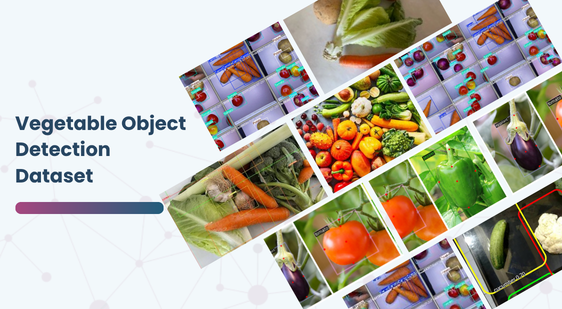
The Vegetable Object Detection Dataset is an image dataset designed for computer vision and object detection tasks involving vegetables. It can help researchers and developers train and test models that identify vegetables within images. In addition, the dataset can support image processing, machine learning, deep learning, and automated vegetable recognition projects.
Dataset Description
The Vegetable Object Detection Dataset provides image data for developing computer vision models that can detect vegetables in visual scenes. Unlike simple image classification, object detection models can identify an object and locate it within an image.
This makes the dataset useful for projects that need both vegetable recognition and object localization. For example, developers can use this type of data to explore how AI systems find vegetables in images and distinguish them from other objects.
Furthermore, the dataset can help users practice common computer vision workflows, including image preparation, annotation handling, model training, and performance testing.
What Is Vegetable Object Detection?
Vegetable object detection uses computer vision to find and identify vegetables in an image. A trained model can learn visual patterns such as shape, color, size, and texture.
Object detection goes one step further than image classification. While classification tells you what an image contains, object detection can also show where the object appears in the image.
Therefore, vegetable object detection can support applications where an AI system needs to recognize vegetables automatically.
What Can This Dataset Be Used For?
The Vegetable Object Detection Dataset can support several computer vision applications.
Vegetable Detection
Researchers can train models to locate vegetables within images. This can help build automated systems that recognize different vegetables in visual scenes.
Computer Vision
The dataset can help developers test computer vision methods for image recognition and object localization.
Machine Learning
Users can use the images to develop and evaluate machine learning models for object detection tasks.
Deep Learning
The dataset can support experiments with deep learning models that learn visual features from training images.
Automated Recognition
Developers can explore systems that automatically identify vegetables in images. Such systems may support smart agriculture, food analysis, inventory systems, or automated sorting projects.
How Object Detection Works With Vegetable Images
A typical object detection workflow starts with labeled images. The model learns visual patterns from these examples during training.
First, users prepare the images and their annotations. Next, they train an object detection model on the prepared data.
After training, the model can process new images and predict the location of objects. It can also assign a class to each detected object.
Finally, users evaluate the model on test images. They can then improve the model by adjusting the training data, model settings, or detection approach.
Machine Learning Applications
The dataset can support a range of machine learning experiments.
For example, users can train an object detection model and measure how accurately it finds vegetables. They can also compare different models to understand which approach works best for their project.
In addition, researchers can study image quality, object size, background conditions, and other factors that may affect detection results.
Common evaluation measures for object detection include:
- Precision
- Recall
- F1-score
- Intersection over Union (IoU)
- Mean Average Precision (mAP)
These metrics can help users understand how well a model detects and locates objects.
Potential Use Cases
Vegetable object detection can support several real-world AI ideas.
Smart Agriculture
AI systems can use image detection to recognize vegetables and support automated crop or produce analysis.
Food Sorting
Computer vision can help automated systems identify and separate different types of produce.
Retail and Inventory
Detection models can help recognize vegetables in images for inventory or product monitoring systems.
Food Recognition
Developers can build applications that identify vegetables from photos or camera feeds.
AI Research
Researchers can use the dataset to test new object detection methods and compare model performance.
Who Can Use This Dataset?
The dataset can benefit:
- Computer vision students
- Machine learning students
- AI developers
- Data science researchers
- Deep learning practitioners
- Computer vision researchers
- Developers building image recognition applications
It can also provide a useful starting point for projects that require object detection with food or agricultural images.
How to Work With the Dataset
Start by reviewing the images and available annotations. Next, check the annotation format and make sure the data matches the requirements of your chosen object detection framework.
After that, split the data into suitable training, validation, and test sets. Then, train an object detection model using the prepared images.
Finally, evaluate the model with suitable detection metrics. If the results need improvement, review difficult images and adjust the training process.
Important Considerations
Image quality can affect object detection results. Factors such as lighting, image background, object size, camera angle, and image quality may influence model performance.
Therefore, users should test their models on images that represent the conditions they expect to see in real applications.
Also, users should check the dataset’s current license and usage terms before using it in commercial projects.
Conclusion
The Vegetable Object Detection Dataset provides a useful resource for exploring vegetable detection with computer vision. It can support object detection, machine learning, deep learning, image processing, and automated recognition projects.
By training models on labeled vegetable images, developers can explore how AI systems locate and identify objects in visual data. In addition, the dataset can help students and researchers build practical experience with computer vision workflows.
Source: Kaggle – Vegetable-Object-Detection.
Contact Us
FAQ
Question 1. What is the Vegetable Object Detection Dataset?
The Vegetable Object Detection Dataset is an image dataset designed for training and testing computer vision models that detect and identify vegetables in images.
Question 2. What can the Vegetable Object Detection Dataset be used for?
It can be used for vegetable detection, object localization, computer vision, machine learning, deep learning, image processing, and automated vegetable recognition.
Question 3. Can this dataset be used for machine learning projects?
Yes. Developers and researchers can use the dataset to train and evaluate machine learning and deep learning models for vegetable object detection.
Question 4. How does vegetable object detection work?
A model learns visual patterns from labeled vegetable images. It then uses those patterns to locate and identify vegetables in new images.
Question 5.Who can use the Vegetable Object Detection Dataset?
Computer vision students, AI developers, machine learning researchers, data scientists, and deep learning practitioners can use the dataset for learning, research, and object detection projects.

Quality Data Creation

Guaranteed TAT

ISO 9001:2015, ISO/IEC 27001:2013 Certified

HIPAA Compliance

GDPR Compliance

Compliance and Security
Let's Discuss your Data collection Requirement With Us
To get a detailed estimation of requirements please reach us.