
Smart City Traffic & Urban Mobility Dataset
Smart City Traffic & Urban Mobility Dataset
Datasets
Smart City Traffic & Urban Mobility Dataset
File
Smart City Traffic, Urban Mobility & IoT Data
Use Case
Smart city research, traffic analysis, urban mobility analysis, IoT applications, transportation analytics, machine learning, and predictive modeling
Description
A structured dataset focused on smart city traffic, urban mobility, and IoT-related analysis. It can support research and machine learning projects involving traffic patterns, mobility systems, intelligent transportation, and smart urban planning.

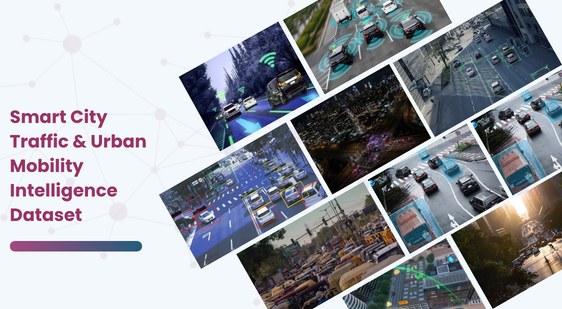
The Smart City Traffic & Urban Mobility Dataset is designed for studying traffic, urban mobility, smart transportation, and IoT-related applications. It can help researchers and data professionals analyze mobility patterns, explore traffic-related trends, and develop machine learning or predictive modeling projects for smarter urban systems.
Dataset Description
Modern cities generate large amounts of transportation and mobility data every day. Traffic conditions, movement patterns, connected devices, and transportation systems can all provide useful information for improving urban planning.
The Smart City Traffic & Urban Mobility Dataset provides a data-driven foundation for exploring these areas. Researchers can use it to study relationships between traffic conditions, mobility, and smart-city technologies.
Moreover, the dataset can support projects that combine transportation analytics with Internet of Things (IoT) concepts. Such projects can help demonstrate how data can contribute to more efficient and connected urban environments.
What Is Smart Urban Mobility?
Smart urban mobility refers to the use of technology and data to improve how people and vehicles move around cities. Instead of relying only on traditional transportation planning, smart mobility uses connected systems, sensors, analytics, and intelligent technologies.
For example, traffic data can help identify busy areas and recurring congestion patterns. Similarly, mobility information can support better transportation planning and infrastructure decisions.
As cities become more connected, data analysis plays an increasingly important role in understanding transportation challenges.
What Can This Dataset Be Used For?
The dataset can support several research and development applications. Depending on the project requirements, users can explore areas such as:
- Traffic pattern analysis
- Urban mobility research
- Smart transportation systems
- IoT-based transportation projects
- Traffic trend analysis
- Mobility analytics
- Machine learning
- Predictive modeling
- Data visualization
- Smart city research
These applications make the dataset useful for both academic research and practical experimentation.
Traffic Analysis
Traffic analysis helps researchers understand how transportation conditions change across different situations. By examining available traffic-related data, analysts can identify patterns and investigate factors associated with congestion and mobility.
For instance, visualization techniques can reveal changes in traffic activity. Machine learning models can then be explored for prediction or classification tasks.
However, traffic behavior can vary significantly between cities and transportation networks. Therefore, results should be interpreted within the context of the data being analyzed.
Urban Mobility Research
Urban mobility involves more than vehicle traffic. It can include broader transportation patterns and the ways people and vehicles move through urban environments.
Researchers can use structured mobility data to explore transportation behavior and identify potential areas for improvement. In addition, these insights can support research into intelligent transportation systems and future mobility solutions.
The dataset can therefore serve as a starting point for studying data-driven approaches to urban mobility.
IoT and Smart Transportation
IoT technology connects physical devices and systems so that they can collect and exchange data. In smart cities, connected technologies can support transportation monitoring and mobility management.
Traffic sensors, connected vehicles, and other smart devices can generate information that helps cities understand transportation conditions. When combined with data analytics, these systems can support more informed decision-making.
Consequently, datasets related to traffic, mobility, and IoT can be useful for experimenting with smart transportation concepts.
Machine Learning Use Cases
Machine learning can provide another way to explore urban mobility data. After cleaning and preparing the dataset, users can investigate different analytical and predictive approaches.
Potential projects include:
Traffic Prediction
Researchers can explore models that predict traffic-related patterns based on available data.
Mobility Pattern Analysis
Clustering and other analytical methods can help identify similarities or recurring patterns within mobility data.
Classification
Machine learning classification techniques can be used when the available data contains suitable categories or target variables.
Predictive Modeling
Researchers can experiment with predictive models to investigate potential transportation outcomes.
Data Visualization
Charts and dashboards can make traffic and mobility patterns easier to understand. Visual analysis can also help identify unusual trends or relationships before developing a machine learning model.
How to Work With the Dataset
Begin by examining the available data and understanding its structure. Next, check for missing values, inconsistent records, and other quality issues.
After cleaning the data, identify the variables that are relevant to your research question. Visualization can then help reveal important patterns.
For machine learning projects, select appropriate features and target variables based on the task. Finally, train and evaluate the selected model using suitable metrics.
This step-by-step approach can make the dataset easier to use for both exploratory research and predictive projects.
Benefits of the Dataset
A structured smart-city dataset can provide a useful foundation for transportation research. Instead of working only with theoretical examples, users can explore data-driven questions related to traffic and mobility.
Furthermore, the dataset can help students and researchers practice important skills such as data cleaning, exploratory data analysis, visualization, feature analysis, and machine learning.
For developers, it can also provide a starting point for experimenting with intelligent transportation and IoT concepts.
Who Can Use This Dataset?
The dataset can be useful for several types of users. Data scientists can explore it for analytics and machine learning projects. Similarly, researchers can use it to investigate smart-city and transportation-related questions.
Students can apply the dataset to academic projects involving data analysis or computer science. Urban planners and transportation researchers may also find its subject area relevant to mobility studies.
Developers working on IoT and smart transportation concepts can use the dataset as a basis for analytical experiments and prototypes.
Important Considerations
Traffic and mobility data can be influenced by many factors. Weather, infrastructure, travel behavior, public transportation, road conditions, events, and local policies may all affect transportation patterns.
Therefore, users should avoid making broad conclusions from limited data. Instead, findings should be evaluated in relation to the dataset’s scope and the specific research question.
Data quality is also important. Missing or inconsistent records can affect analytical results, so appropriate preprocessing and validation should be performed before drawing conclusions.
Conclusion
The Smart City Traffic & Urban Mobility Dataset provides a useful foundation for exploring traffic analysis, urban mobility, smart transportation, and IoT-related research.
Researchers and developers can apply the dataset to data visualization, machine learning, predictive modeling, and transportation analytics. Furthermore, it can help students understand how real-world data can contribute to smarter and more connected urban systems.
As cities continue to adopt connected technologies, data-driven transportation research can play an important role in understanding mobility challenges and exploring potential solutions.
Source: Kaggle – Smart City Traffic & Urban Mobility Dataset
Contact Us
FAQ
Question 1. What is the Smart City Traffic & Urban Mobility Dataset?
The Smart City Traffic & Urban Mobility Dataset is a structured dataset focused on traffic, urban mobility, smart transportation, and IoT-related applications.
Question 2. What can the Smart City Traffic & Urban Mobility Dataset be used for?
It can be used for traffic analysis, urban mobility research, smart transportation projects, IoT applications, machine learning, predictive modeling, and data visualization.
Question 3. Can this dataset be used for machine learning?
Yes. The dataset can support machine learning experiments involving traffic analysis, mobility patterns, classification, predictive modeling, and other suitable analytical tasks.
Question 4. Who can use this smart city dataset?
Data scientists, students, researchers, transportation analysts, urban planning professionals, and developers working on smart-city or IoT projects can use the dataset.
Question 5. Why is urban mobility data important for smart cities?
Urban mobility data can help researchers understand transportation patterns and investigate ways to improve traffic management, mobility planning, and intelligent transportation systems.

Quality Data Creation

Guaranteed TAT

ISO 9001:2015, ISO/IEC 27001:2013 Certified

HIPAA Compliance

GDPR Compliance

Compliance and Security
Let's Discuss your Data collection Requirement With Us
To get a detailed estimation of requirements please reach us.