
Oral Dataset
Oral Dataset
Datasets
Oral Dataset
File
Dataset files containing oral and dental health data
Use Case
Machine Learning, Deep Learning, Dental Image Analysis, Oral Health Research
Description
A dataset focused on oral and dental health that can be used for data analysis, classification, and AI-based research in dentistry.

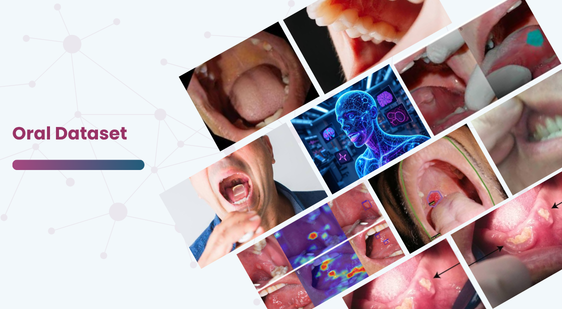
The Oral Dataset is a useful resource for exploring oral and dental health with data science, machine learning, deep learning, and artificial intelligence. Researchers can use it to study oral-health-related data and explore computational methods for dental research.
In addition, the dataset can help students, data scientists, developers, and researchers understand how AI techniques can support healthcare and dental technology projects.
What Is the Oral Dataset?
The Oral Dataset supports research and experimentation related to oral health. Depending on the available data and labels, users can explore tasks such as classification, pattern recognition, data analysis, and visualization.
Furthermore, oral and dental datasets can help researchers investigate AI applications in healthcare. For example, computer vision and machine learning models can analyze relevant data and identify patterns that may support research.
However, researchers should review the original dataset files before selecting a specific modeling task. The available data determines which machine learning methods and applications are appropriate.
Key Highlights
The Oral Dataset offers several potential benefits for AI and research projects:
- Focuses on oral and dental health data
- Supports machine learning and AI research
- Can help with exploratory data analysis
- Useful for academic and educational projects
- Can support classification and pattern-recognition experiments
- Relevant to dental AI and healthcare technology
- Available through Kaggle for research and experimentation
Potential Dataset Features
The exact structure of the Oral Dataset should be checked in the original dataset files before starting a project. Depending on the available data, users may work with:
- Oral-health-related observations
- Dental or oral images, where available
- Category or class labels
- Attributes related to oral conditions
- Data used for training and evaluation, where provided
Therefore, users should check the original documentation to confirm the exact variables, labels, file formats, and metadata.
Machine Learning Applications
The Oral Dataset can support different machine learning and deep learning workflows. The right approach will depend on the type of data and the research objective.
Oral Health Classification
Researchers can explore classification models to distinguish between different categories represented in the dataset. This approach can help users study how machine learning handles oral-health-related data.
Dental Image Classification
If the dataset contains labeled dental or oral images, researchers can use it for image classification experiments. A model can learn visual patterns from the available training examples and classify new images.
Deep Learning
For image-based tasks, researchers can experiment with deep learning models such as convolutional neural networks (CNNs). They can also compare transfer-learning approaches to understand how different architectures perform.
Exploratory Data Analysis
Researchers can analyze the dataset to identify patterns, distributions, trends, and possible outliers. Moreover, visualization can help users understand relationships between available variables or categories.
Healthcare AI Research
The dataset can also support experimental research into artificial intelligence for oral and dental healthcare. Such projects can explore how AI may assist researchers with data analysis and image-based tasks.
Recommended Data Preprocessing
Before training a model, users should prepare the data carefully. A structured preprocessing workflow can improve data quality and reduce potential errors.
Recommended steps include:
- First, inspect the dataset structure and available files.
- Next, check for missing, corrupted, or invalid records.
- Then, examine the available labels and class distribution.
- Remove duplicate observations or images when appropriate.
- Normalize or standardize numerical variables when required.
- For image projects, resize and normalize images according to model requirements.
- Encode categorical variables when necessary.
- Create suitable training, validation, and test sets.
- Finally, check for possible data leakage between different data splits.
For healthcare and dental image projects, researchers should take extra care with patient-level data. If patient identifiers exist, images from the same patient should not unintentionally appear in both training and test sets.
Suitable Machine Learning Models
The best model depends on the dataset structure and the target task. For structured data, researchers can experiment with:
- Logistic Regression
- Decision Trees
- Random Forest
- Support Vector Machines
- Gradient Boosting
- XGBoost
- Neural Networks
For image-based projects, suitable approaches may include:
- Convolutional Neural Networks (CNNs)
- ResNet
- EfficientNet
- DenseNet
- Vision Transformers
- Transfer-learning models
However, researchers should select a model based on the data type, dataset size, research goal, available computing resources, and evaluation method.
Dataset Evaluation
Model evaluation should go beyond accuracy, especially when the dataset contains multiple classes or an uneven class distribution.
Researchers can use metrics such as:
- Precision
- Recall
- F1-score
- Specificity
- Sensitivity
- ROC-AUC
- Confusion matrix
- Balanced accuracy
Additionally, researchers should select metrics that match the specific task. For example, precision and recall can provide more useful information than accuracy when class distribution varies significantly.
Who Can Use the Oral Dataset?
The Oral Dataset can benefit several groups, including:
- Students learning machine learning and data science
- Researchers studying dental and oral healthcare
- Data scientists developing healthcare-related models
- AI developers exploring dental computer vision
- Academic institutions conducting educational projects
- Healthcare technology researchers investigating AI applications
Furthermore, the dataset can provide hands-on experience for learners who want to explore machine learning in dentistry and oral healthcare.
Oral Dataset Project Ideas
Researchers and students can explore several project ideas with the dataset, depending on its available data and labels.
Classification Projects
Build and compare machine learning models for oral-health-related classification tasks.
Dental Image Recognition
If labeled images are available, experiment with CNNs or transfer-learning models for image recognition.
Model Comparison
Train multiple algorithms and compare their performance using precision, recall, F1-score, and other relevant metrics.
Explainable AI
Explore techniques that help researchers understand which features or image regions influence model predictions.
Data Visualization
Create visual reports to identify patterns, class distributions, and relationships within the available dataset.
Deep Learning Experiments
Compare different neural network architectures to evaluate their performance on relevant oral-health tasks.
Important Considerations
Because oral healthcare involves medical information, researchers should interpret machine learning results carefully. A model may perform well on one dataset but produce different results when researchers test it on new populations or data sources.
Therefore, users should examine data quality, class balance, labeling accuracy, image quality, demographic representation, and possible dataset bias.
Researchers should also check for data leakage before evaluating a model. In addition, they should use appropriate validation methods to understand how well the model generalizes.
Most importantly, researchers should not present an experimental model as a clinically validated diagnostic system. Any AI system intended for diagnosis or patient care requires appropriate clinical testing, validation, and professional oversight.
Conclusion
The Oral Dataset provides a useful resource for exploring machine learning, computer vision, and AI applications in oral and dental healthcare. Researchers and developers can use it to study data patterns, experiment with classification methods, and explore deep learning approaches.
Moreover, the dataset can support academic and educational projects focused on applying AI techniques to healthcare-related data. Users should review the original dataset information and licensing terms before using or redistributing the data.
Source: Kaggle – Oral Dataset
Contact Us
FAQ
Question 1. What is the Oral Dataset?
The Oral Dataset is a dataset related to oral and dental health that can be used for data analysis, machine learning, deep learning, and healthcare AI research.
Question 2. What can the Oral Dataset be used for?
It can be explored for oral-health data analysis, classification, computer vision, deep learning, and research into artificial intelligence applications in dentistry.
Question 3. Is the Oral Dataset suitable for deep learning?
If the dataset contains appropriately labeled image data, it can be suitable for experimenting with CNNs, transfer learning, and other deep learning approaches. Users should verify the available files and labels before selecting a model.
Question 4. Can the dataset be used for medical diagnosis?
The dataset can support research and experimentation, but a model trained on it should not be treated as a clinically validated diagnostic system. Clinical applications require additional validation, appropriate data, and professional oversight.
Question 5. What models can be trained on the dataset?
Depending on the data format, users can experiment with traditional machine learning algorithms, neural networks, CNNs, transfer-learning models, or other modern computer vision architectures.

Quality Data Creation

Guaranteed TAT

ISO 9001:2015, ISO/IEC 27001:2013 Certified

HIPAA Compliance

GDPR Compliance

Compliance and Security
Let's Discuss your Data collection Requirement With Us
To get a detailed estimation of requirements please reach us.