
Name Entity Recognition (NER) Dataset
Name Entity Recognition (NER) Dataset
Datasets
Name Entity Recognition (NER) Dataset
File
Name Entity Recognition (NER) Data
Use Case
Named entity recognition, natural language processing, text classification, information extraction, sequence labeling, machine learning, and deep learning
Description
The Name Entity Recognition (NER) Dataset contains annotated text from the GMB corpus, with words labeled according to named entity categories. It includes sentence identifiers, individual words, part-of-speech tags, and NER tags for training and evaluating NLP models.
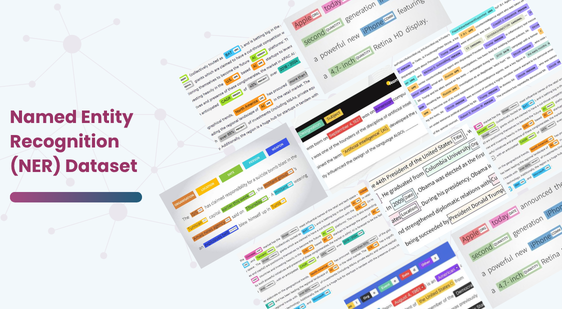
The Name Entity Recognition (NER) Dataset is an annotated text dataset designed for natural language processing and named entity recognition tasks. It is derived from the Groningen Meaning Bank (GMB) corpus and contains 47,959 sentences with approximately 1.35 million words.
Each word receives a corresponding entity tag, allowing machine learning models to learn how to identify important entities within text. In addition, the dataset includes part-of-speech information, which can provide an additional linguistic feature during model development.
The dataset follows a token-level annotation structure. Therefore, developers can group individual words into sentences and train sequence-labeling models for NER applications.
Key Features
47,959 annotated sentences
Approximately 1.35 million words
Word-level named entity annotations
Sentence identifiers for grouping tokens into sentences
Part-of-speech (POS) tags
Named entity recognition (NER) tags
Suitable for sequence-labeling tasks
Useful for NLP and information extraction projects
Supports machine learning and deep learning experiments
Data Included in the NER Dataset
The dataset contains four primary columns:
| Column | Description |
|---|---|
Sentence # | Identifies the sentence associated with each word |
Word | Individual word or token from the text |
POS | Part-of-speech tag assigned to the word |
Tag | Named entity recognition label assigned to the word |
The Sentence # column allows users to reconstruct complete sentences from individual token rows. Meanwhile, Word contains the actual text, POS provides grammatical information, and Tag identifies the named entity category.
Named Entity Categories
The dataset contains multiple entity categories that represent different types of information in text. These include:
Geographical entities (geo)
Organizations (org)
Persons (per)
Geopolitical entities (gpe)
Time indicators (tim)
Artifacts (art)
Events (eve)
Natural phenomena (nat)
The annotation scheme also uses beginning and inside tags to represent multi-word entities. For example, B- identifies the beginning of an entity while I- identifies a subsequent token within the same entity. The O tag represents tokens that do not belong to a named entity.
Applications of the Name Entity Recognition Dataset
Named Entity Recognition
Train NLP models to identify people, organizations, locations, dates, and other entities within unstructured text.
Information Extraction
Extract structured information from documents, articles, reports, and other text sources.
Natural Language Processing
Use the annotated text to develop and evaluate NLP pipelines for entity identification and text understanding.
Sequence Labeling
The token-level structure makes the dataset suitable for sequence-labeling models such as CRF, BiLSTM, and transformer-based architectures.
Text Classification
Combine entity information with other linguistic features to improve text classification and document analysis workflows.
Machine Learning and Deep Learning
The dataset can support experiments with traditional machine learning algorithms as well as deep learning models for NLP. Researchers have used the dataset for models involving BiLSTM, CRF, and other sequence-processing approaches.
Why Use the NER Dataset?
The dataset provides a large collection of annotated text for practical NER experiments. Moreover, its word-level labels allow models to learn how entity information appears within sentences rather than relying only on document-level classifications.
The inclusion of POS tags provides additional linguistic information. As a result, researchers can experiment with different feature combinations when building NER systems.
Furthermore, the dataset covers several entity types, including people, organizations, geographical locations, time expressions, events, and artifacts. Therefore, it can support a range of information extraction and NLP applications.
Who Can Use This Dataset?
The Name Entity Recognition Dataset can be useful for:
NLP researchers
Machine learning developers
Data scientists
AI researchers
NLP students
Deep learning practitioners
Information extraction developers
Natural language processing teams
Researchers building sequence-labeling models
Conclusion
The Name Entity Recognition (NER) Dataset provides a substantial collection of annotated text for developing and evaluating NLP models. With approximately 47,959 sentences, around 1.35 million words, POS information, and entity-level tags, it offers a useful resource for named entity recognition and information extraction.
Researchers and developers can use the dataset to experiment with sequence-labeling models, NLP pipelines, and machine learning approaches for identifying entities in unstructured text.
ThisDataset is available on Kaggle.
Contact Us
FAQ
Question 1. What is the Name Entity Recognition (NER) Dataset?
The Name Entity Recognition (NER) Dataset is an annotated text dataset based on the GMB corpus. It provides word-level labels for identifying different types of named entities in text.
Question 2. How many sentences are included in the NER Dataset?
The dataset contains approximately 47,959 sentences and around 1.35 million words.
Question 3. What columns are included in the NER Dataset?
The dataset includes Sentence #, Word, POS, and Tag columns. These fields identify sentences, individual words, part-of-speech information, and named entity labels.
Question 4. What entity types are included in the NER Dataset?
The dataset includes categories such as geographical entities, organizations, persons, geopolitical entities, time indicators, artifacts, events, and natural phenomena.
Question 5. What can the NER Dataset be used for?
The dataset can support named entity recognition, information extraction, natural language processing, sequence labeling, text analysis, machine learning, and deep learning projects.

Quality Data Creation

Guaranteed TAT

ISO 9001:2015, ISO/IEC 27001:2013 Certified

HIPAA Compliance

GDPR Compliance

Compliance and Security
Let's Discuss your Data collection Requirement With Us
To get a detailed estimation of requirements please reach us.