
Multilingual Synthetic OCR Starter Dataset
Multilingual Synthetic OCR Starter Dataset
Datasets
Multilingual Synthetic OCR Starter Dataset
File
Multilingual Synthetic OCR Starter Dataset
Use Case
Optical character recognition (OCR), text detection, text recognition, machine learning, computer vision research, and document digitization.
Description
The Multilingual Synthetic OCR Starter Dataset supports experiments with synthetic text images. Developers and researchers can explore OCR model development, text extraction, and image processing using the available data.
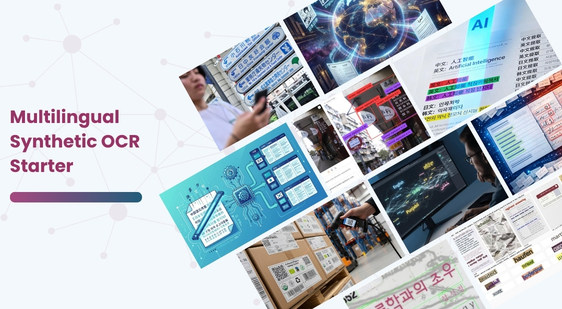
The Multilingual Synthetic OCR Starter Dataset helps developers explore optical character recognition (OCR) and computer vision tasks. It provides a starting point for experiments involving text images and machine learning. Moreover, synthetic OCR data can help developers train models to recognize text patterns and convert image-based text into machine-readable content.
Dataset Overview
Optical character recognition allows computers to extract text from images. For example, OCR systems can process scanned documents, forms, and other images containing text. Therefore, developers need suitable training data to build and evaluate these systems.
The Multilingual Synthetic OCR Starter Dataset supports experiments with synthetic text images. Developers can use the available data to explore image preprocessing, text recognition, and OCR model development. However, they should first review the dataset files to confirm the supported languages, image formats, annotation types, and sample counts.
Key Features of the Dataset
Synthetic OCR Data: Provides a starting point for experiments with artificially generated text images.
Text Recognition: Helps developers explore methods for converting image-based text into machine-readable content.
Text Detection: Supports text localization experiments when the dataset includes suitable region annotations.
Labeled Examples: Enables supervised learning experiments when images include corresponding text labels or other relevant annotations.
Computer Vision Applications: Supports OCR model development, image processing, and text extraction research.
Furthermore, developers should check the available annotations before choosing a model or training approach.
Applications of the Dataset
Optical Character Recognition
Developers can use OCR techniques to extract text from images. As a result, they can explore workflows that convert visual information into searchable, machine-readable content.
Text Detection and Recognition
Text detection identifies the location of text within an image, while text recognition identifies the characters or words. Together, these tasks help developers build more complete OCR pipelines.
Document Processing
OCR can help automate text extraction from scanned documents, forms, and image-based records. However, performance depends on image quality, text layout, and the training data available.
Machine Learning Research
Students and researchers can use synthetic text images to practice image preprocessing, model training, and evaluation. In addition, they can compare different approaches to determine which methods work best for their chosen task.
Multilingual OCR Development
Multilingual OCR systems aim to recognize text across different languages and writing systems. Therefore, developers should confirm the dataset’s actual language coverage before using it for multilingual experiments.
Conclusion
The Multilingual Synthetic OCR Starter Dataset provides a useful starting point for exploring OCR, text recognition, and computer vision. Moreover, synthetic examples can support model development while reducing the need to collect every training image manually.
However, developers should also test their models on representative real-world images to evaluate performance under different conditions.
This dataset is sourced from Kaggle.
Contact Us
FAQ
Question 1. What is the Multilingual Synthetic OCR Starter Dataset?
It is a dataset designed to support OCR and machine learning experiments involving synthetic text images.
Question 2. What is OCR used for?
OCR converts text in images into machine-readable content. For example, it can help process scanned documents, forms, and image-based records.
Question 3. Can this dataset support text detection?
Yes, provided that the dataset includes suitable text-region annotations. These annotations help models learn to locate text within images.
Question 4. Can synthetic data help train OCR models?
Yes. Synthetic data provides examples for training and experimentation. However, developers should also evaluate their models on real-world images to assess practical performance.
Question 5. Which applications can benefit from OCR datasets?
OCR datasets can support document digitization, text extraction, automated document processing, image-based information retrieval, and computer vision research.

Quality Data Creation

Guaranteed TAT

ISO 9001:2015, ISO/IEC 27001:2013 Certified

HIPAA Compliance

GDPR Compliance

Compliance and Security
Let's Discuss your Data collection Requirement With Us
To get a detailed estimation of requirements please reach us.