
Emotions Dataset for NLP
Oral Dataset
Datasets
Emotions Dataset for NLP
File
Emotions Text Classification Data
Use Case
Emotion classification, NLP, text classification, sentiment and emotion analysis, machine learning, deep learning, emotion recognition, conversational AI research
Description
A labeled text dataset designed for emotion classification and natural language processing. It can support machine learning and deep learning projects focused on identifying emotions in text, text classification, emotion recognition, and NLP research.

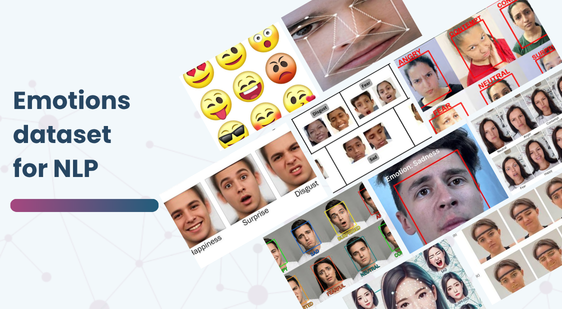
The Emotions Dataset for NLP is a text classification dataset for emotion detection and natural language processing (NLP). It contains text samples with six emotion categories: joy, sadness, anger, fear, love, and surprise. Therefore, researchers can use it for emotion classification, text analysis, machine learning, and NLP research.
Emotions Dataset for NLP Overview
Understanding emotions in written language plays an important role in natural language processing. Text can express different feelings, such as joy, sadness, anger, fear, love, or surprise. However, models need labeled examples to learn these emotional patterns.
The Emotions Dataset for NLP provides text samples with corresponding emotion labels. As a result, it works well for supervised learning and multiclass text classification.
Researchers and developers can also use the dataset to explore emotion recognition, text analysis, and different NLP approaches.
What Is the Emotions Dataset for NLP?
The Emotions Dataset for NLP is a labeled text dataset for emotion classification. Each text sample has an associated emotion category.
The dataset commonly includes these six emotion classes:
Joy
Sadness
Anger
Fear
Love
Surprise
Research using this dataset reports around 20,000 text samples across training, validation, and test sets. One reported split includes 16,000 training samples, 2,000 validation samples, and 2,000 test samples.
Because the dataset provides labeled text, researchers can train and evaluate models that predict emotions in new text.
What Can the Emotions Dataset Be Used For?
The dataset supports several NLP and machine learning applications. In particular, researchers can use it to study how language relates to different emotional categories.
Emotion Classification
First, emotion classification focuses on predicting the emotion expressed in a text sample. A model learns patterns from labeled examples and then predicts an emotion for new text.
As a result, the dataset provides a useful foundation for developing and testing multiclass classification models.
Natural Language Processing
The dataset can support several NLP tasks, including:
Text preprocessing
Tokenization
Feature extraction
Text classification
Emotion recognition
Text representation
Model evaluation
For example, researchers can convert text into numerical features with TF-IDF. They can then use those features to train a traditional machine learning classifier.
Sentiment and Emotion Analysis
Sentiment analysis usually focuses on broad categories such as positive, negative, or neutral. In contrast, emotion classification aims to identify more specific emotions.
Therefore, this dataset helps researchers explore how different language patterns connect with emotional expressions.
Chatbots and Conversational AI
Emotion recognition can also provide useful signals for conversational AI systems. For example, a model can identify an emotional category in a user’s message and use that result as an additional input.
However, developers should not treat an emotion prediction as a perfect interpretation of a person’s actual emotional state.
Machine Learning Applications
The Emotions Dataset for NLP works well for both traditional machine learning and deep learning experiments.
For traditional approaches, researchers can combine text features with models such as:
Naive Bayes
Logistic Regression
Support Vector Machines
Decision Trees
K-Nearest Neighbors
For example, researchers can apply TF-IDF to the text and then train a multiclass classifier. This approach also provides a simple way to compare different algorithms.
In addition, researchers can explore neural networks and transformer-based models for more advanced NLP experiments.
Deep Learning and Transformer Models
Modern NLP models can represent text using contextual embeddings. Unlike simple keyword-based methods, these representations can capture relationships between words and their surrounding context.
Researchers can experiment with approaches such as:
LSTM networks
Recurrent neural networks
BERT-based models
Transformer architectures
As a result, these approaches can help researchers study more complex patterns in emotional language.
The dataset has also appeared in research and practical projects involving transformer-based emotion recognition.
Potential Use Cases
The dataset can support research and development in several areas, such as:
Emotion detection from text
NLP classification
Customer feedback analysis
Social media text analysis
Conversational AI
Chatbot development
Emotion-aware applications
NLP education
Machine learning benchmarking
In addition, researchers can use the dataset to compare traditional NLP methods with deep learning and transformer-based approaches.
Why Is Emotion Classification Important?
Human language often contains emotional information that adds context to a message. For example, two people may discuss the same topic while expressing completely different emotions.
Therefore, emotion classification can help applications analyze the emotional tone of written communication.
However, emotion detection remains challenging. People often use sarcasm, slang, indirect language, or ambiguous expressions. Because of this, a model may sometimes predict the wrong emotion.
For this reason, researchers should evaluate model performance carefully. They should also avoid treating every prediction as a direct representation of a person’s actual emotional state.
Who Can Use This Dataset?
The Emotions Dataset for NLP can benefit:
Data scientists
Machine learning developers
NLP researchers
AI developers
Students learning NLP
Academic researchers
Developers building text classification systems
It is especially useful for projects that require labeled text and a multiclass emotion classification task.
Important Considerations
Before using the dataset, review the data quality, class distribution, and label consistency to ensure that the data fits your project requirements.
Also, remember that the emotion labels represent categories assigned to text samples. They do not provide a clinically validated assessment of a person’s emotional or mental health. For production applications, test the model with relevant and diverse data before relying on its predictions.
Conclusion
The Emotions Dataset for NLP provides labeled text for emotion classification and NLP projects. Its six emotion categories make it useful for machine learning, deep learning, text classification, and emotion-aware AI applications.
Researchers can use the dataset to practice text preprocessing, feature extraction, model training, and evaluation.
Contact Us
FAQ
Question 1. What is the Emotions Dataset for NLP?
The Emotions Dataset for NLP is a labeled text dataset designed for emotion classification and natural language processing tasks.
Question 2. What emotions are included in the dataset?
The dataset includes six commonly reported emotion categories: joy, sadness, anger, fear, love, and surprise.
Question 3. What can the Emotions Dataset for NLP be used for?
It can be used for emotion classification, NLP research, text analysis, machine learning, deep learning, and emotion-aware AI applications.
Question 4. Can this dataset be used for machine learning projects?
Yes. The dataset can be used to train and evaluate machine learning models for multiclass emotion classification.
Question 5. Can the dataset be used for deep learning?
Yes. Researchers can use the labeled text to experiment with deep learning and transformer-based NLP models for emotion recognition and text classification.

Quality Data Creation

Guaranteed TAT

ISO 9001:2015, ISO/IEC 27001:2013 Certified

HIPAA Compliance

GDPR Compliance

Compliance and Security
Let's Discuss your Data collection Requirement With Us
To get a detailed estimation of requirements please reach us.