
Diabetes Prediction Dataset
Diabetes Prediction Dataset
Datasets
Diabetes Prediction Dataset
File
Diabetes Prediction Data
Use Case
Diabetes prediction, healthcare analytics, machine learning, classification, predictive modeling, health data analysis, and medical research.
Description
A structured dataset containing medical and demographic information for diabetes prediction. It can support machine learning models, healthcare analytics, feature analysis, classification tasks, and research focused on identifying patterns associated with diabetes.

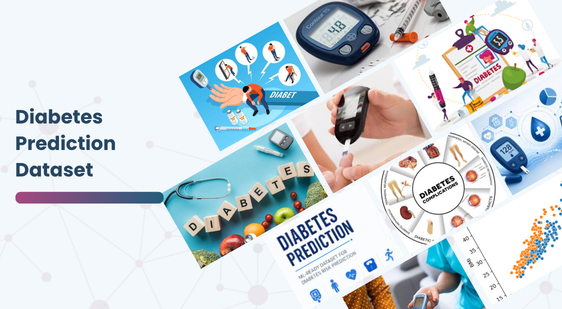
The Diabetes Prediction Dataset is a machine learning dataset containing medical and demographic information from 100,000 patients, along with a diabetes status label. It includes factors such as age, gender, BMI, hypertension, heart disease, smoking history, HbA1c level, and blood glucose level. The dataset can support diabetes prediction, classification, healthcare analytics, and machine learning research.
Diabetes Prediction Dataset: Overview
The Diabetes Prediction Dataset is a structured healthcare dataset designed for diabetes analysis and machine learning projects. It contains 100,000 records and 9 variables, covering demographic details, health conditions, lifestyle information, and clinical measurements.
The dataset includes factors such as age, gender, BMI, hypertension, heart disease, smoking history, HbA1c level, and blood glucose level, along with a diabetes status label. These features provide useful inputs for exploring patterns in patient data and developing classification models.
Researchers, data scientists, and machine learning developers can use the dataset to study diabetes-related patterns, perform feature analysis, and build predictive models
Dataset Features
The dataset includes the following key variables:
Gender – Gender information associated with each patient record.
Age – Age of the patient.
Hypertension – Indicates whether hypertension is present.
Heart Disease – Indicates whether heart disease is present.
Smoking History – Records information about smoking history.
BMI – Body Mass Index measurement.
HbA1c Level – HbA1c measurement related to blood glucose control.
Blood Glucose Level – Blood glucose measurement.
Diabetes – The target variable indicating diabetes status.
What Is Diabetes Prediction?
Diabetes prediction uses data analysis and machine learning to identify patterns associated with diabetes status. A model can learn from patient records and their target labels. It can then classify new records based on the patterns it learned during training.
However, a machine learning prediction should not replace professional medical diagnosis. This dataset is best suited to research, education, and model development rather than direct clinical decision-making.
What Can the Diabetes Prediction Dataset Be Used For?
The dataset supports several machine learning and healthcare analytics applications.
Diabetes Classification
The dataset can be used to develop binary classification models that predict the diabetes label from available patient features.
Machine Learning Research
Developers can test classification algorithms, compare model performance, tune parameters, and study how different features affect predictions.
Healthcare Analytics
Researchers can analyze relationships between demographic information, health conditions, clinical measurements, and diabetes status.
Risk Analysis
The dataset can help researchers explore patterns associated with diabetes status. For example, they can examine how BMI, blood glucose, HbA1c, age, and other variables relate to model predictions.
Feature Analysis
Data scientists can evaluate which available features contribute most to model performance and compare different feature-selection approaches.
Machine Learning Applications
The Diabetes Prediction Dataset can support a typical supervised machine learning workflow.
First, users can clean the data and check missing or inconsistent values. Next, they can encode categorical variables and prepare numerical features for modeling.
After that, the dataset can be divided into training and testing sets. Researchers can then train classification algorithms and compare their results using suitable evaluation metrics.
Common metrics include:
Accuracy
Precision
Recall
F1-score
ROC-AUC
Confusion matrix
Because healthcare classification datasets can contain an imbalance between target classes, researchers should also look beyond accuracy when evaluating a model.
Why Is This Dataset Useful for AI Projects?
Healthcare machine learning requires structured data that combines relevant patient characteristics with a clearly defined target. This dataset provides that combination in a relatively simple format.
With 100,000 records and nine variables, it also gives learners enough data to practice preprocessing, exploratory analysis, classification, and model evaluation.
In addition, researchers have used this dataset in diabetes prediction studies and machine learning projects, showing its relevance for experimentation with predictive models.
Who Can Use the Diabetes Prediction Dataset?
This dataset can be useful for:
Data science students
Machine learning developers
Healthcare analytics researchers
AI researchers
Python and Scikit-learn learners
Academic researchers
Students working on classification projects
It can also serve as a practical dataset for learning how to build and evaluate supervised machine learning models.
How to Work With the Dataset
A typical workflow starts with exploratory data analysis. Users can inspect the feature distributions, identify unusual values, and examine relationships between variables.
Next, they can prepare categorical and numerical features for machine learning. After preprocessing, they can split the data into training and testing sets.
Finally, they can train several classification models and compare their results. Researchers should also check for class imbalance and avoid treating model predictions as medical diagnoses.
Important Considerations
The dataset is intended for data analysis and machine learning applications. It should not be treated as a substitute for clinical assessment.
Researchers should also review data quality, class distribution, preprocessing choices, and model bias before drawing conclusions from their results. A strong evaluation should include appropriate metrics and testing methods rather than relying only on accuracy.
Conclusion
The Diabetes Prediction Dataset provides structured medical and demographic data for diabetes classification, healthcare analytics, and machine learning research. With 100,000 records covering factors such as age, gender, BMI, hypertension, heart disease, smoking history, HbA1c, blood glucose, and diabetes status, the dataset offers a useful foundation for predictive modeling projects.
Researchers, data scientists, and machine learning developers can use it to practice data preprocessing, feature analysis, classification, and model evaluation. It can also support research and educational projects focused on healthcare data and diabetes prediction.
The Diabetes Prediction Dataset is sourced from Kaggle.
Contact Us
FAQ
Question 1. What is the Diabetes Prediction Dataset?
The Diabetes Prediction Dataset is a structured dataset containing medical and demographic information that can be used for diabetes classification, healthcare analytics, and machine learning research.
Question 2. How many records are included in the Diabetes Prediction Dataset?
The dataset contains 100,000 patient records with 9 variables related to demographic information, health conditions, and clinical measurements.
Question 3. What can the Diabetes Prediction Dataset be used for?
It can be used for diabetes prediction, machine learning, classification, healthcare analytics, feature analysis, predictive modeling, and medical research.
Question 4. Can this dataset be used for machine learning projects?
Yes. The dataset can be used to train and evaluate supervised machine learning models for diabetes classification and predictive analysis.
Question 5. What features are included in the Diabetes Prediction Dataset?
The dataset includes features such as age, gender, BMI, hypertension, heart disease, smoking history, HbA1c level, blood glucose level, and diabetes status.

Quality Data Creation

Guaranteed TAT

ISO 9001:2015, ISO/IEC 27001:2013 Certified

HIPAA Compliance

GDPR Compliance

Compliance and Security
Let's Discuss your Data collection Requirement With Us
To get a detailed estimation of requirements please reach us.