
2D Masks Presentation Attack Detection Dataset
2D Masks Presentation Attack Detection Dataset
Datasets
2D Masks Presentation Attack Detection Dataset
File
2D Masks Presentation Attack Detection Dataset
Use Case
Face Anti-Spoofing, Liveness Detection, Biometric Security, Presentation Attack Detection, Computer Vision
Description
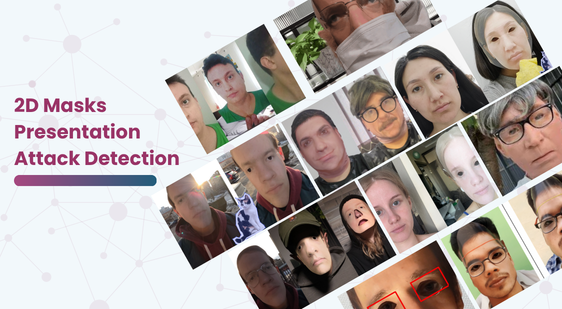
The 2D Masks Presentation Attack Detection Dataset includes real face videos, printed 2D mask attacks, and cut-out eye mask videos for training and evaluating face anti-spoofing, liveness detection, and biometric security models.
Description:
As facial recognition technology becomes increasingly integrated into mobile devices, banking applications, access control systems, and digital identity platforms, the need for reliable anti-spoofing mechanisms has never been greater. While facial authentication offers convenience and security, it also faces threats from presentation attacks such as printed photos, paper masks, and other spoofing techniques.
Download Dataset
The 2D Masks Presentation Attack Detection Dataset has been developed to support the creation of advanced face liveness detection and anti-spoofing solutions. This dataset contains videos of real individuals, printed 2D mask attacks, and cut-out eye mask attacks captured under diverse environmental conditions. By providing realistic attack scenarios, the dataset enables developers and researchers to train machine learning models capable of distinguishing genuine users from fraudulent attempts.
Dataset Overview
This is a video-based biometric dataset focused on facial presentation attacks.
The dataset contains three main categories:
- Real — genuine facial presentations
- Mask — printed 2D facial mask attacks
- Cut — printed 2D masks with cut-out eye regions
The videos were recorded in different lighting conditions and locations, including indoor and outdoor environments. The sample also includes people wearing accessories such as glasses, caps, hats, and scarves.
Key Features of the Dataset
Real and Spoof Facial Presentations
The dataset includes both genuine facial videos and multiple types of spoof attacks, making it suitable for binary and multi-class classification tasks.
Multiple Attack Types
Researchers can evaluate system performance against different presentation attack methods, including:
- Printed 2D face masks
- Printed masks with cut-out eye regions
- Genuine facial presentations
Video-Based Dataset
Unlike image-only datasets, this collection provides short video sequences that allow models to analyze:
- Facial movements
- Eye behavior
- Texture patterns
Diverse Recording Conditions
Videos are captured in a variety of environments, including:
- Indoor locations
- Outdoor locations
- Different lighting conditions
Dataset Structure
The sample contains 17 participant folders, with 12 videos for each person.
Each participant includes:
Real
- Real_1
- Real_2
- Real_3
Mask
- Mask_1
- Mask_2
- Mask_3
Cut
- Cut_1
- Cut_2
- Cut_3
The accompanying CSV file provides the participant information and references to the corresponding videos, making the dataset easier to organize for machine learning workflows.
Applications of the Dataset
Face Liveness Detection
Develop models that determine whether a facial presentation originates from a live person or a spoofing attack.
Biometric Authentication Systems
Improve facial recognition security in:
- Smartphones
- Banking applications
- Access control systems
- Identity verification platforms
Presentation Attack Detection (PAD)
Train systems specifically designed to detect fraudulent biometric presentations.
Computer Vision Research
Support research in:
- Facial motion analysis
- Temporal feature extraction
- Video classification
- Deep learning-based security systems
Benefits for Machine Learning and Deep Learning
The dataset offers several advantages for AI model development:
Realistic Attack Scenarios
Includes common attack methods observed in real-world biometric systems.
Video-Based Learning
Supports temporal analysis techniques that improve spoof detection accuracy.
Diverse Environmental Conditions
Helps models generalize across different lighting and background settings.
Multiple Presentation Classes
Enables binary and multi-class classification experiments.
Conclusion
The 2D Masks Presentation Attack Detection Dataset provides a valuable resource for organizations, researchers, and developers working to strengthen biometric security systems. By combining genuine facial presentations with realistic printed mask attacks and cut-out eye spoofing attempts, the dataset enables the development of more accurate and reliable face anti-spoofing solutions.
This dataset is sourced from Kaggle.
Contact Us
FAQ
Question 1. What is the 2D Masks Presentation Attack Detection Dataset?
It is a biometric video dataset containing genuine facial presentations, printed mask attacks, and cut-out eye mask attacks designed for face anti-spoofing and liveness detection research.
Question 2. What types of spoof attacks are included?
The dataset includes:
- Printed 2D mask attacks
- Printed masks with cut-out eye regions
- Genuine facial presentations
Question 3. Is the dataset suitable for liveness detection systems?
Yes. The dataset is specifically designed to support face liveness detection and presentation attack detection applications.
Question 4. Can this dataset be used for deep learning projects?
Absolutely. The dataset is suitable for CNNs, Transformers, LSTMs, and other deep learning architectures used in biometric security applications.
Question 5. Which industries can benefit from this dataset?
Industries including banking, fintech, cybersecurity, access control, identity verification, and biometric authentication can benefit from this dataset.

Quality Data Creation

Guaranteed TAT

ISO 9001:2015, ISO/IEC 27001:2013 Certified

HIPAA Compliance

GDPR Compliance

Compliance and Security
Let's Discuss your Data collection Requirement With Us
To get a detailed estimation of requirements please reach us.