
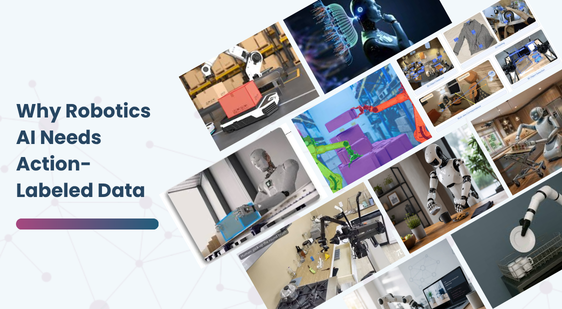
Why Robotics AI Needs Action-Labeled Data
Robots are moving beyond simple, pre-programmed tasks. Modern robots can recognize objects, understand instructions, navigate environments, and make decisions in real time. But seeing an object is only one part of the problem. A robot also needs to know what action to take next.
That is why action-labeled data for robotics AI is becoming essential. It connects what a robot sees and understands with the physical action required to complete a task.
What Is Action-Labeled Data?
Action-labeled data is training data that links a robot’s observations with specific actions.
For example, a training sample may include:
- Visual input: A cup is detected on a table.
- Instruction: “Pick up the cup.”
- Action label: Move the robotic arm, position the gripper, close the gripper, and lift.
- Outcome: The cup is successfully picked up.
This type of data teaches an AI system not only to recognize its environment but also to respond appropriately.
Why Action Labels Matter in Robotics
Traditional computer vision datasets often focus on identifying objects, people, or locations. While this information is useful, robots need a deeper understanding of their surroundings.
A warehouse robot, for example, may recognize a package but still need to determine how to approach it, where to grip it, and where to place it.
Action-labeled datasets help bridge the gap between perception and physical behavior.
They allow robotics models to learn relationships such as:
See → Understand → Decide → Act → Evaluate
This makes training more relevant to real-world robotic applications.
Action-Labeled Data Supports Robot Learning
Robots operate in environments where conditions constantly change. Objects can move, lighting can vary, and unexpected obstacles can appear.
High-quality action-labeled training data exposes AI models to these variations. It can include information such as:
- Robot movements and trajectories
- Object interactions
- Gripper positions
- Human demonstrations
- Task instructions
- Successful and failed actions
- Environmental changes
- Sensor and camera observations
With enough diverse examples, robotics AI can learn patterns that help it perform tasks more reliably.
The Role of Action Data in Vision-Language-Action Models
Vision-Language-Action (VLA) models are an important development in robotics AI. These systems combine visual information, natural language, and physical actions.
For example, a user could tell a robot, “Move the red box to the shelf.” The model must identify the box, understand the instruction, locate the shelf, plan the movement, and execute the task.
Action-labeled data provides the training connection between the instruction and the robot’s physical behavior.
Without sufficient action data, a model may understand what the user wants but struggle with how to perform it.
Where Robotics AI Uses Action-Labeled Data
Action-labeled datasets can support a wide range of applications, including:
Industrial Robots
Robots can learn assembly, inspection, sorting, and material-handling tasks.
Warehouse Automation
Training data can help robots pick, move, sort, and organize products.
Service Robots
Robots can learn tasks such as object delivery, navigation, and human interaction.
Autonomous Systems
Action data can support decision-making for robots operating in dynamic environments.
Humanoid Robotics
Humanoid robots require large amounts of interaction data to learn everyday physical tasks.
What Makes a Good Robotics Action Dataset?
Not all action-labeled data is equally useful. A strong robotics dataset should provide accurate labels, diverse scenarios, consistent annotation, and realistic task examples.
It should also capture the relationship between perception, instructions, actions, and outcomes. Diversity is particularly important because robots must operate outside controlled laboratory environments.
Data quality matters just as much as dataset size. Incorrect action labels can teach a model the wrong behavior and reduce its reliability.
The Future of Robotics Training Data
As robotics AI becomes more capable, training datasets will need to move beyond static images and videos. Robots need interactive, multimodal, and action-oriented data that reflects how tasks actually happen in the physical world.
Action-labeled data will therefore play a central role in training robots that can understand instructions, interact with objects, adapt to changing environments, and complete complex tasks.
Conclusion
Action-labeled data helps robotics AI connect what it sees with what it needs to do. From warehouse robots to humanoid systems, high-quality action data enables smarter, more reliable task execution.
Explore GTS.ai for high-quality AI training data and datasets that support next-generation robotics and machine learning applications.


