
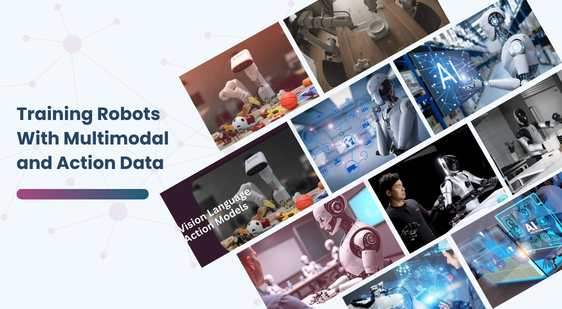
Robots are moving beyond simple, pre-programmed tasks and becoming capable of understanding complex environments, responding to instructions, and performing flexible actions. A major reason for this progress is the use of multimodal and action data—training information that combines what a robot sees, hears, understands, and does.
What Is Multimodal Data?
Multimodal data comes from multiple sources or “modes” of information. For robots, this can include camera images, video, audio, text instructions, depth information, touch signals, and sensor readings.
For example, a robot may receive a camera image of a kitchen along with the instruction, “Pick up the red cup and place it on the table.” To complete the task, the robot needs to understand the words, identify objects in the image, determine their positions, and plan the required movements.
Training robots with these different data types helps them build a more complete understanding of the world rather than relying on a single sensor or input.
The Importance of Action Data
Multimodal information tells a robot what is happening, but action data tells it what to do.
Action data can include robot movements, joint positions, gripper states, trajectories, and sequences of successful actions. Demonstrations from humans or other robots can show how a task should be performed.
For instance, a training example might contain:
Instruction → Visual observation → Robot action → Result
“Open the drawer” → Image of drawer → Reach, grip, and pull → Drawer opens.
Thousands or millions of such examples can help machine-learning systems connect perception with physical behavior.
Combining Perception and Action
The real power comes from combining multimodal data with action data. Instead of simply recognizing an object, a robot can learn how recognition should influence its behavior.
Consider a household robot asked to clean a table. It may use vision to identify dishes, language understanding to interpret the task, depth sensors to estimate distances, and action data to determine how to grasp and move each item.
This creates a learning loop:
See → Understand → Plan → Act → Observe the result → Adjust.
Such systems can become more adaptable because they learn relationships between the environment and their own actions.
How Data Is Collected
Robot-training datasets can be created in several ways. Human operators can remotely control robots to demonstrate tasks. Robots can also learn from recorded videos, simulations, synthetic environments, and interactions with real-world objects.
Simulation is particularly useful because it allows researchers to generate large amounts of training data without risking expensive hardware. However, transferring skills learned in simulation to the physical world remains an important challenge.
Challenges in Robot Training
Collecting high-quality multimodal action data is difficult. Robots must accurately synchronize sensor information with actions, while datasets need to represent different environments, objects, lighting conditions, and task variations.
Another challenge is safety. A model that performs well in a digital environment may behave unpredictably when controlling a physical robot. Training therefore requires careful testing, monitoring, and safeguards.
Data diversity also matters. If a robot is trained on limited examples, it may struggle when confronted with unfamiliar objects or situations.
The Future of Multimodal Robot Learning
As AI advances, robots are becoming better at learning from language, vision, demonstrations, and multimodal data. This helps them understand their surroundings, follow natural-language instructions, learn from experience, and adapt their actions to different situations.
Multimodal and action data are helping build more flexible and intelligent robots for real-world applications. Explore GTS for high-quality multimodal training data, robotics datasets, and AI data solutions that support advanced AI and robotic applications.


