
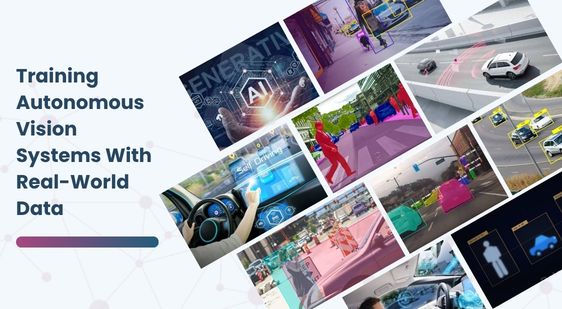
Training Autonomous Vision Systems With Real-World Data
Autonomous vision systems help machines understand their surroundings and make decisions with limited human intervention. From self-driving vehicles and delivery robots to industrial machines and drones, these systems depend heavily on visual data.
The quality and diversity of training data can directly affect how well an autonomous system performs in real-world environments. While synthetic data can support model development, real-world data provides the complexity, variation, and unexpected situations that autonomous vision systems must learn to handle.
What Are Autonomous Vision Systems?
Autonomous vision systems use cameras and computer vision models to perceive and interpret their surroundings. They can identify objects, understand scenes, estimate distances, track movement, and recognize environmental conditions.
For example, an autonomous vehicle may need to detect:
- Pedestrians and cyclists
- Cars, trucks, and motorcycles
- Traffic signs and signals
- Road markings
- Obstacles and construction zones
- Different road and weather conditions
The system uses this visual information to support decisions such as slowing down, changing direction, or avoiding an obstacle.
Why Real-World Data Matters
Real-world environments are rarely predictable. Lighting changes throughout the day, objects appear from unexpected locations, and weather conditions can affect visibility.
Real-world datasets capture these variations naturally. They can include busy streets, crowded areas, unusual objects, shadows, reflections, occlusions, and other conditions that may be difficult to reproduce completely with synthetic data.
Training with diverse real-world examples helps vision models become more robust when they encounter situations outside controlled testing environments.
Key Types of Data for Autonomous Vision
Different autonomous applications require different forms of visual training data.
Image Data
Images provide individual snapshots of environments and are commonly used for object detection, classification, and segmentation.
Video Data
Video captures movement over time. It is useful for tasks such as object tracking, activity recognition, and understanding how vehicles or pedestrians move through a scene.
3D and Depth Data
Depth information helps systems estimate the position and distance of objects. This can be particularly important for navigation and obstacle avoidance.
Multimodal Data
Advanced autonomous systems may combine camera data with other sensor information, such as LiDAR, radar, GPS, or vehicle data. Combining multiple sources can provide a more complete understanding of the environment.
Data Annotation Is Critical
Raw images and videos are not always enough to train supervised vision models. They often need detailed annotations that tell the model what is present in each frame.
Common annotation types include:
- Bounding boxes for object detection
- Polygons for segmentation
- Keypoints for pose estimation
- Tracking IDs for moving objects
- Class labels for categorization
Accurate annotation is particularly important for autonomous systems because small labeling errors can affect model behavior.
Diversity Improves Model Generalization
A strong autonomous vision dataset should represent the environments where the system will operate.
This may involve collecting data across different:
- Locations
- Weather conditions
- Lighting conditions
- Camera positions
- Traffic or crowd densities
- Object types
- Road or terrain conditions
For example, a vehicle vision model trained primarily on clear daytime footage may perform poorly at night or during heavy rain. Including these conditions in the training data can improve its ability to generalize.
Real-World Data and Autonomous AI
Training autonomous systems requires more than simply collecting millions of images. Data needs to be carefully selected, cleaned, annotated, validated, and organized according to the model’s objectives.
A well-designed dataset can help teams identify difficult scenarios, evaluate model performance, and improve systems through repeated training and testing.
Conclusion
Real-world data plays an important role in developing reliable autonomous vision systems. It exposes models to the unpredictable conditions that machines encounter outside controlled environments.
From annotated images and video to 3D and multimodal sensor data, diverse training datasets provide the foundation for building computer vision systems capable of understanding complex environments.
As autonomous technology continues to evolve, high-quality real-world training data will remain essential for improving perception, generalization, and real-world performance.
Explore GTS.ai for AI training datasets and data solutions supporting computer vision and autonomous AI development.


