
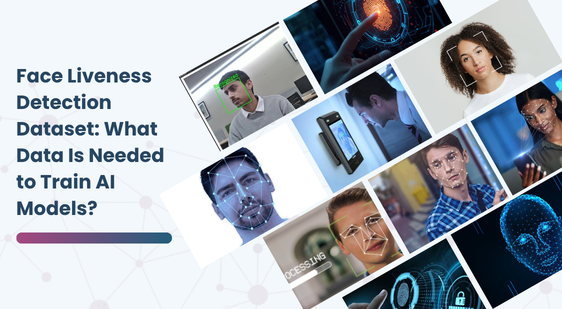
A face liveness detection dataset needs both real face samples and spoof samples. This allows AI models to learn the difference between a genuine person and a presentation attack. For example, useful data can include live selfies, videos, printed photos, screen replays, and masks.
In addition, the dataset should cover different cameras, lighting conditions, facial poses, environments, and subjects. Accurate labels and metadata are also important because they help developers train, test, and improve liveness detection models.
What Is a Face Liveness Detection Dataset?
A face liveness detection dataset is a collection of facial images or videos used to train AI systems to determine whether a face is live or spoofed.
In simple terms, the model needs to answer: “Is this a real person in front of the camera?”
For instance, an attacker might use a printed photograph or a video displayed on a smartphone to bypass facial recognition. Therefore, liveness detection adds an additional security layer to biometric systems.
It can be used for:
- Identity verification
- Digital KYC
- Banking security
- Access control
- Biometric authentication
- Remote onboarding
What Data Does the Dataset Need?
A good dataset should contain several types of data. These include live faces, spoof attacks, environmental variations, device information, and detailed labels.
1. Live Face Images and Videos
First, collect genuine samples of real people. These can include selfies, photographs, and video sequences.
The dataset should contain different:
- Facial expressions
- Head movements
- Poses
- Camera angles
- Distances
- Natural movements
Furthermore, video samples can provide temporal information, such as blinking and facial movement.
2. Printed Photo Attacks
Next, include printed photographs as spoof samples. These attacks are important because an attacker can present another person’s photograph to a camera.
To improve diversity, use photographs with different:
- Print qualities
- Sizes
- Paper types
- Viewing angles
- Distances
- Brightness levels
As a result, the model can learn to identify different forms of printed-photo attacks.
3. Screen and Video Replay Attacks
In addition to printed photos, include digital replay attacks. For example, a face can be displayed on a smartphone, tablet, laptop, or monitor.
The dataset should vary screen brightness, display quality, distance, and viewing angle. This is especially useful because high-resolution screens can produce convincing spoof samples.
4. Advanced Spoof Attacks
For more comprehensive projects, the dataset can include 3D masks and facial replicas.
However, the required attack types depend on the intended application. A high-security biometric system may need more advanced attacks than a basic research project.
Environmental and Device Diversity
A reliable face liveness detection dataset should represent real-world conditions.
Therefore, include different:
- Lighting conditions
- Indoor and outdoor environments
- Smartphones and webcams
- Camera resolutions
- Backgrounds
- Facial poses
For example, a user may verify their identity in bright daylight or in a poorly lit room. Consequently, the model should not depend on one specific lighting condition.
Camera diversity is also important because different devices produce different exposure, color, sharpness, and compression characteristics.
What Labels Should Be Included?
At minimum, each sample should have a Live or Spoof label.
However, additional metadata can make the dataset more useful.
| Field | Example |
|---|---|
| Label | Live / Spoof |
| Attack type | Print / Replay / Mask |
| Subject ID | Subject_001 |
| Device | Android |
| Lighting | Low |
| Environment | Indoor |
| Pose | Frontal |
| Modality | RGB |
This information helps developers understand where a model performs well or fails.
Image vs. Video Data
Both formats can be useful. However, they provide different information.
Images can help models learn texture, reflections, screen artifacts, and other visual characteristics.
Videos, on the other hand, provide temporal information. For example, models can analyze facial movement, blinking, and changes between frames.
Therefore, the best format depends on the target application and model architecture.
How Large Should the Dataset Be?
There is no universal number of samples required for a good liveness detection model.
Instead, diversity is often more important than simply increasing the sample count.
For example, 100,000 similar images from one camera may be less useful than a smaller dataset containing multiple subjects, devices, environments, and attack types.
Therefore, focus on:
- Subject diversity
- Attack diversity
- Camera diversity
- Lighting variation
- Multiple recording sessions
How Should the Dataset Be Split?
Finally, divide the data into training, validation, and test sets.
However, avoid placing the same subjects in both training and testing whenever possible. Otherwise, the model may learn characteristics of familiar faces and produce misleadingly high results.
A subject-independent test set can provide a more realistic measure of model performance.
What Makes a Good Face Liveness Detection Dataset?
A strong dataset should include:
- Real face images and videos
- Printed photo attacks
- Screen and video replays
- Advanced attacks where relevant
- Different cameras and devices
- Multiple lighting conditions
- Diverse subjects
- Different poses and expressions
- Accurate labels
- Useful metadata
- Separate test data
Most importantly, the dataset should reflect the conditions in which the AI model will actually be deployed.
Final Takeaway
A face liveness detection dataset should contain much more than ordinary facial images. Instead, it should combine genuine faces with realistic spoof attacks and variations in devices, lighting, environments, and subjects.
Furthermore, detailed labels and carefully separated test data help developers build and evaluate more reliable AI models. By focusing on quality, diversity, and realistic attack scenarios, organizations can create training data that better supports real-world face liveness detection.


