
Pets & Animal Ownership Dataset
Pets & Animal Ownership Dataset
Datasets
Pets & Animal Ownership
File
Pets & Animal Ownership Dataset
Use Case
Pet ownership analysis, animal ownership research, demographic analysis, data visualization, statistical analysis, and machine learning
Description
The Pets & Animal Ownership Dataset provides data related to pet and animal ownership patterns. It can support research and analysis of pet ownership behavior, animal preferences, household characteristics, and related trends.
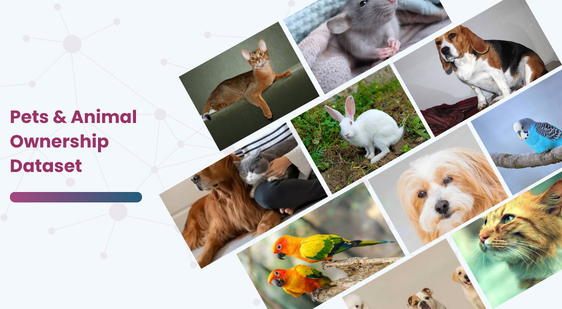
The Pets & Animal Ownership Dataset provides a useful resource for exploring patterns related to household pets and animal ownership. Researchers and analysts can use this type of data to study which animals people own and identify trends in pet ownership.
Pet ownership datasets can also support demographic and behavioral analysis. For example, researchers may compare ownership patterns across different groups, examine preferences for different animal types, and identify relationships between household characteristics and pet ownership.
Moreover, animal ownership data can help researchers understand how people interact with companion animals. This makes the dataset useful for data analysis, visualization, and research projects focused on pets and animal ownership.
Key Features
- Data related to pets and animal ownership
- Supports analysis of different animal ownership patterns
- Useful for studying pet ownership preferences
- Suitable for demographic and behavioral analysis
- Can support statistical analysis and data visualization
- Useful for academic and exploratory data analysis
- Suitable for machine learning experiments after appropriate preprocessing
Pet and Animal Ownership Analysis
The dataset can help users explore patterns in animal ownership. For instance, analysts can examine which types of pets appear more frequently and compare ownership trends across available categories.
Furthermore, researchers can use the data to identify relationships between pet ownership and other available attributes. This can provide insights into household preferences and animal ownership behavior.
However, users should review the original dataset fields before performing detailed statistical analysis. The available variables and their definitions should guide the selection of analytical methods.
Applications of the Pets & Animal Ownership Dataset
Pet Ownership Analysis
Analyze patterns in pet ownership and identify commonly owned animals.
Animal Preference Research
Study preferences for different types of pets and compare ownership patterns.
Demographic Analysis
If demographic variables are available in the dataset, researchers can examine relationships between household or personal characteristics and pet ownership.
Data Visualization
Create charts and dashboards to visualize animal ownership patterns, pet categories, and other available variables.
Statistical Research
Use the dataset for descriptive statistics, correlation analysis, group comparisons, and other exploratory research methods.
Machine Learning
After appropriate preprocessing, the dataset can support classification, clustering, or prediction experiments based on the available variables.
Why Use the Pets & Animal Ownership Dataset?
The Pets & Animal Ownership Dataset provides a practical starting point for studying how people own and interact with pets and other animals. In addition, it can support exploratory data analysis and visualization projects.
Researchers can use the dataset to identify ownership patterns and compare different animal categories. Therefore, it can be useful for students, analysts, and researchers working on social, behavioral, or animal-related datasets.
Furthermore, the dataset can serve as a learning resource for practicing data cleaning, exploratory analysis, visualization, and statistical techniques.
Who Can Use This Dataset?
The dataset can be useful for:
- Data analysts
- Data science students
- Researchers
- Social science researchers
- Animal behavior researchers
- Pet industry analysts
- Machine learning practitioners
- Business analysts
- Data visualization professionals
- Students working on statistical projects
Conclusion
The Pets & Animal Ownership Dataset provides a useful resource for studying pet and animal ownership patterns. It can support exploratory data analysis, statistical research, data visualization, and machine learning experiments.
Researchers and analysts can use the dataset to explore animal ownership trends, compare available categories, and investigate relationships between pet ownership and other available variables.
The Pets & Animal Ownership dataset is available on Kaggle.
Contact Us
FAQ
Question 1. What is the Pets & Animal Ownership Dataset?
The Pets & Animal Ownership Dataset contains data related to pet and animal ownership. It can support research into pet ownership patterns, animal preferences, demographic analysis, and related trends.
Question 2. What can the Pets & Animal Ownership Dataset be used for?
The dataset can support pet ownership analysis, animal preference research, demographic analysis, statistical research, data visualization, and machine learning projects.
Question 3. Can the dataset be used for pet ownership analysis?
Yes. Researchers can analyze available ownership-related variables to identify patterns, compare animal categories, and study pet ownership trends.
Question 4. Can the Pets & Animal Ownership Dataset be used for machine learning?
Yes. After appropriate preprocessing and feature selection, the dataset can support machine learning experiments such as classification, clustering, or prediction.
Question 5. Who can use the Pets & Animal Ownership Dataset?
Data analysts, students, researchers, data scientists, animal-related researchers, and machine learning practitioners can use the dataset for analysis and research projects.

Quality Data Creation

Guaranteed TAT

ISO 9001:2015, ISO/IEC 27001:2013 Certified

HIPAA Compliance

GDPR Compliance

Compliance and Security
Let's Discuss your Data collection Requirement With Us
To get a detailed estimation of requirements please reach us.