
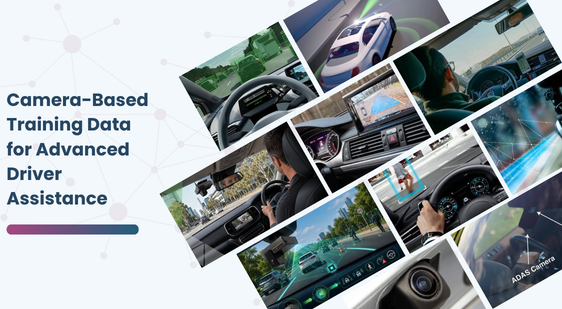
Advanced Driver Assistance Systems (ADAS) use cameras and AI models to understand road environments and support drivers with functions such as lane detection, object detection, and collision warnings. Camera-based training data for advanced driver assistance helps these models learn to identify vehicles, pedestrians, road signs, lanes, and other important road elements.
Quick Answer
Camera-based training data for ADAS consists of images and videos captured from vehicle-mounted cameras. The data can include road scenes across different traffic conditions, weather, lighting, road types, and camera viewpoints. Accurate annotations help AI models detect objects, recognize lanes, understand road scenes, and support ADAS functions.
What Is Camera-Based Training Data for ADAS?
Camera-based training data includes visual information collected from cameras installed inside or around vehicles.
Depending on the ADAS application, datasets can contain:
- Front-facing road images
- Rear and side camera footage
- Dashcam videos
- Multi-camera recordings
- Lane and road-marking data
- Traffic sign and traffic light images
- Vehicle and pedestrian data
- Driving-scene videos
Annotations add useful information to this visual data. For example, bounding boxes can identify vehicles, while lane annotations can show road boundaries.
Key Data Types for ADAS
Different ADAS features require different types of camera data.
Vehicle and Object Detection
Models need images and videos containing cars, trucks, motorcycles, bicycles, pedestrians, and other road users. Bounding boxes or segmentation masks can help models identify these objects.
Lane Detection
Lane-marking data helps AI systems understand road boundaries and lane structures. Datasets should include different road layouts, faded markings, curves, intersections, and road surfaces.
Traffic Sign and Signal Recognition
Images of traffic signs and signals help models recognize speed limits, stop signs, warnings, traffic lights, and other road information.
Driver Monitoring
Interior camera data can support systems that monitor driver attention, head position, eye movement, and other visual indicators.
Why Diverse Camera Data Matters
ADAS models operate in constantly changing environments. Therefore, training data should represent a wide range of real-world conditions.
Useful diversity includes:
- Day and night driving
- Sunny, cloudy, and low-light conditions
- Rain, fog, and snow
- Urban and highway environments
- Heavy and light traffic
- Different road surfaces
- Different camera positions
- Various vehicle types
For example, a lane detection model trained mainly on clear daytime roads may face difficulties when lane markings become less visible during rain or at night.
Important Annotations for ADAS Training
Accurate annotation helps models connect visual patterns with road objects and events.
Common annotation types include:
- Bounding boxes: Locate vehicles, pedestrians, and signs.
- Semantic segmentation: Separates road areas, lanes, vehicles, and other regions.
- Instance segmentation: Distinguishes individual objects.
- Lane annotation: Identifies lane boundaries and markings.
- Object tracking: Follows objects across video frames.
- Traffic sign labels: Classify different road signs and signals.
Video annotations can also provide temporal information for tracking and behavior analysis.
Building High-Quality Camera Training Data
Start by defining the ADAS feature and its target operating conditions. Then collect camera data that reflects those conditions.
Next, apply consistent annotation guidelines. Quality checks should review labels, missing annotations, image quality, duplicates, and difficult scenes.
Dataset splits also require attention. Separate training, validation, and test samples carefully to reduce data leakage and provide a more realistic evaluation.
Finally, test the dataset against challenging conditions such as occlusion, glare, motion blur, poor lighting, and crowded roads.
Applications of Camera-Based ADAS Data
Camera training data supports several driver assistance functions, including:
- Forward collision warning
- Automatic emergency braking
- Lane departure warning
- Lane keeping assistance
- Traffic sign recognition
- Pedestrian detection
- Blind-spot monitoring
- Driver monitoring
- Road-scene understanding
The exact role of camera data depends on the ADAS system and its sensor configuration.
Challenges in Camera-Based ADAS Data
Real-world driving creates difficult visual conditions. Weather, glare, shadows, occlusion, motion blur, and low-light scenes can affect image quality.
Another challenge involves representing rare but important events. High-quality datasets need enough challenging examples to help models recognize situations that occur less frequently.
Data privacy, consent, licensing, and secure handling also matter when collecting road and driver footage.
Future of Camera-Based ADAS Training Data
ADAS datasets are becoming more diverse as vehicle systems use higher-resolution cameras, multi-camera setups, video sequences, and sensor fusion.
AI-assisted annotation can accelerate labeling, while human review can help maintain accuracy. More representative datasets can support models that handle different roads, environments, weather conditions, and driving scenarios.
Final Takeaway
Camera-based training data for advanced driver assistance provides the visual foundation for ADAS models that detect road objects, understand lanes, recognize traffic signs, and interpret driving environments. Diverse camera footage, accurate annotations, and realistic road conditions can support more capable driver assistance systems.
GTS provides data collection, annotation, and AI training data solutions for automotive computer vision and ADAS applications.


