
Iris Species Dataset
Iris Species Dataset
Datasets
Iris Species
File
Iris Species Dataset Files
Use Case
Machine learning, classification, data analysis, species prediction, statistical analysis, and educational projects
Description
The Iris Species dataset contains 150 flower samples representing three iris species. It includes measurements for sepal length, sepal width, petal length, and petal width, along with the corresponding species label.
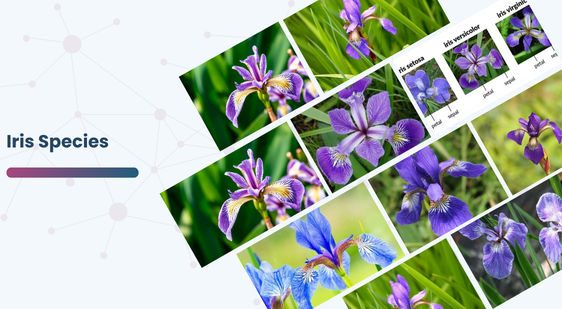
The Iris Species dataset is one of the most widely used datasets for learning and demonstrating classification techniques. R.A. Fisher introduced the original Iris dataset in his 1936 work on taxonomic classification. Today, researchers, students, and developers continue to use it for machine learning experiments and statistical analysis.
The dataset contains 150 flower samples divided equally among three species: Iris Setosa, Iris Versicolor, and Iris Virginica. Each species contains 50 samples. Moreover, the dataset provides four key measurements that describe each flower: sepal length, sepal width, petal length, and petal width.
Because of its small and structured format, the dataset provides a practical starting point for classification projects. For example, developers can use the measurements to build models that predict the species of an iris flower.
Key Features
The Iris Species dataset includes several useful characteristics:
- 150 flower samples
- Three iris species
- 50 samples for each species
- Four numerical flower measurements
- Sepal length and width measurements
- Petal length and width measurements
- Species classification target
- Structured tabular data
- Suitable for classification experiments
- No missing values in the original UCI dataset
Furthermore, the Kaggle version includes an Id column alongside the four measurements and the Species column.
Data Included in the Iris Species Dataset
The dataset contains the following columns:
| Column | Description |
|---|---|
| Id | Identifier for each flower sample |
| SepalLengthCm | Sepal length measured in centimeters |
| SepalWidthCm | Sepal width measured in centimeters |
| PetalLengthCm | Petal length measured in centimeters |
| PetalWidthCm | Petal width measured in centimeters |
| Species | Iris species associated with each sample |
The four flower measurements act as predictive features, while the species column provides the classification target. The three target classes are Iris-setosa, Iris-versicolor, and Iris-virginica.
Applications of the Iris Species Dataset
Machine Learning Classification
The dataset provides a simple environment for developing classification models. Therefore, users can train models to predict an iris species from its physical measurements.
Species Prediction
Developers can use the four flower measurements to create models that predict whether a sample belongs to Setosa, Versicolor, or Virginica.
Data Analysis
The structured format also makes the dataset useful for exploratory data analysis. For example, users can compare measurements across species and identify patterns in the data.
Statistical Research
Researchers can use the dataset to demonstrate statistical methods and classification techniques. Moreover, its small size makes experimentation relatively straightforward.
Machine Learning Education
Students often use the Iris dataset to understand important machine learning workflows. These include data preparation, feature analysis, model training, prediction, and evaluation.
Data Visualization
Users can visualize relationships between sepal and petal measurements. As a result, the dataset can help demonstrate how different features relate to classification outcomes.
Why Use the Iris Species Dataset?
The Iris Species dataset offers a simple and well-structured environment for machine learning experiments. Because it contains only a small number of samples and features, users can focus on understanding classification concepts without managing a complex dataset.
Moreover, the three balanced species classes make it useful for introductory classification experiments. Researchers and students can compare different algorithms and evaluate their predictions using the same set of flower measurements.
However, the dataset represents a relatively simple classification problem. Therefore, users should not treat results from this dataset as representative of complex real-world machine learning applications.
Who Can Use This Dataset?
The Iris Species dataset can support:
- Machine learning students
- Data science students
- Researchers
- Python developers
- Data analysts
- Statistics learners
- Machine learning practitioners
- Educational projects
- Classification experiments
In addition, developers can use it to practice building and evaluating basic classification models.
Conclusion
The Iris Species dataset provides a simple and useful resource for learning machine learning classification and data analysis. With 150 samples, three iris species, and four measurable flower characteristics, it gives users a clear environment for experimenting with classification models.
Moreover, its structured format makes it suitable for students, researchers, and developers who want to practice data analysis and machine learning techniques.
The dataset is sourced from Kaggle
Contact Us
FAQ
Question 1. What is the Iris Species dataset?
The Iris Species dataset is a classic machine learning dataset containing 150 flower samples from three iris species. It includes measurements for sepal length, sepal width, petal length, and petal width.
Question 2. How many samples are included in the Iris Species dataset?
The dataset contains 150 samples. Each of the three iris species contributes 50 samples.
Question 3. What species are included in the Iris Species dataset?
The dataset includes Iris Setosa, Iris Versicolor, and Iris Virginica. Each species has 50 samples.
Question 4. What features are included in the Iris Species dataset?
The main flower measurements include sepal length, sepal width, petal length, and petal width. The Kaggle version also includes an Id column and a Species target column.
Question 5. What can the Iris Species dataset be used for?
The dataset can support machine learning classification, species prediction, data analysis, statistical research, data visualization, and educational projects.

Quality Data Creation

Guaranteed TAT

ISO 9001:2015, ISO/IEC 27001:2013 Certified

HIPAA Compliance

GDPR Compliance

Compliance and Security
Let's Discuss your Data collection Requirement With Us
To get a detailed estimation of requirements please reach us.