
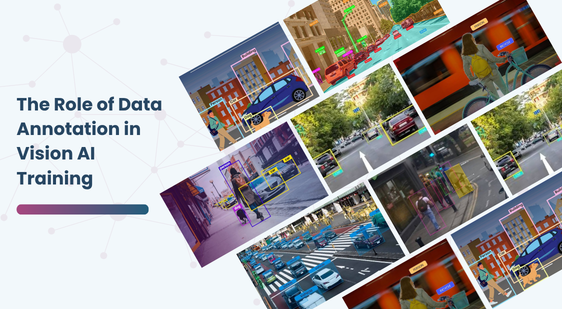
Artificial intelligence is changing how machines understand and interact with the visual world. From autonomous vehicles and medical imaging to facial recognition and retail automation, computer vision helps AI systems interpret images and videos. However, these systems need more than raw visual data to learn effectively. Data annotation gives visual data the structure and meaning that AI models need for training.
What Is Data Annotation?
Data annotation involves labeling or tagging data so that machine learning models can understand its content. In computer vision, teams can identify objects, outline boundaries, classify images, or mark specific points within an image.
For example, an image of a road may contain cars, pedestrians, traffic lights, road signs, and lanes. An annotation team labels each element so that an AI model can learn to recognize similar objects in new images.
Why Is Data Annotation Important for Vision AI?
Computer vision models rely heavily on accurate and consistent training data. High-quality annotations help models learn the visual characteristics and patterns of different objects and environments.
In contrast, inaccurate labels can introduce errors during training. For example, incorrect object categories or poorly defined boundaries can teach a model the wrong visual patterns. As a result, the model may produce unreliable predictions.
Therefore, data annotation forms a critical part of Vision AI development. Accurate labels give models clearer examples and help them learn more effectively.
Common Types of Image Annotation
Different computer vision applications require different annotation techniques. Common methods include:
Bounding Boxes: Annotators draw rectangular boxes around objects to identify their location.
Polygon Annotation: Annotators outline objects with irregular shapes using multiple points.
Semantic Segmentation: Annotators assign each pixel to a specific class, such as road, vehicle, or building.
Instance Segmentation: Annotators identify individual objects separately, even when several objects belong to the same category.
Keypoint Annotation: Annotators mark specific points, such as facial landmarks or human joints, for detailed analysis.
Image Classification: Annotators assign one or more labels to an entire image based on its content.
The right annotation method depends on the AI application and the level of visual detail the model needs.
The Impact of Annotation Quality
Data quality directly affects AI training and model performance. Clear annotation guidelines, consistent labeling standards, and regular quality checks can reduce errors and improve dataset reliability.
For large-scale projects, organizations can combine human annotation with automated or AI-assisted labeling. Automated tools can handle repetitive tasks quickly, while human reviewers can check complex cases and correct inaccurate labels.
Dataset diversity also plays an important role. Training data should include different lighting conditions, environments, object appearances, camera angles, and real-world situations. A diverse and accurately annotated dataset helps models handle unfamiliar visual scenarios more effectively.
Applications Across Industries
Data annotation supports computer vision applications across many industries.
In healthcare, annotated medical images can help train AI systems to identify specific visual patterns. In automotive technology, annotated images and videos can help models recognize vehicles, pedestrians, road markings, and traffic signs.
Retail companies use annotated visual data for product recognition, shelf analysis, and inventory management. In agriculture, annotation can help AI systems identify crops, weeds, and signs of plant disease.
Manufacturing and security also use labeled visual data for inspection, monitoring, object detection, and automated analysis.
The Future of Data Annotation
As Vision AI continues to advance, organizations will need high-quality annotated datasets for increasingly complex applications. At the same time, annotation workflows will continue to evolve through automation, active learning, and human-in-the-loop systems.
These approaches can help teams improve annotation speed while maintaining quality. However, automation alone cannot replace careful quality checks. Human reviewers still play an important role when datasets contain complex objects, unusual scenarios, or ambiguous examples.
The goal goes beyond creating more labeled data. Organizations need accurate, diverse, consistent, and relevant datasets that help AI models learn useful visual patterns.
Conclusion
Data annotation remains a fundamental part of Vision AI training. It transforms raw images and videos into structured training data that AI models can use to learn about objects, scenes, and visual patterns.
As computer vision expands across industries, organizations need efficient annotation workflows, diverse datasets, and strong quality-control processes. GTS provides data annotation and computer vision training data solutions to support the development of reliable and capable AI systems.
In short, accurate annotations create better training data, and better training data helps build more capable Vision AI systems.


