
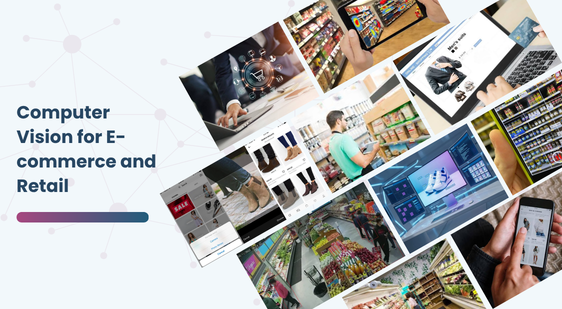
Computer Vision for e-commerce and retail helps businesses analyze images and videos to understand products, customers, stores, and shopping environments. With high-quality visual training data, computer vision systems can support product recognition, visual search, inventory monitoring, checkout automation, shelf analysis, and personalized shopping experiences.
What Is Computer Vision in E-commerce and Retail?
Computer vision enables AI systems to interpret visual information from cameras, product images, videos, and other sources.
In e-commerce, it can analyze product images to identify categories, attributes, colors, shapes, and visual similarities. In physical retail stores, computer vision can analyze shelves, products, customer movement, and store environments.
As a result, retailers can automate visual tasks that would otherwise require significant manual effort.
Key Applications of Computer Vision
Product Recognition
Computer vision models can identify products from images or video. This capability can support automated cataloging, product matching, and inventory systems.
For example, a retailer can use product recognition to identify an item captured by a store camera and connect it with its product information.
Visual Search
Visual search allows shoppers to search for products using images instead of text.
A customer could upload a picture of a chair, shoe, or clothing item and receive visually similar products. This creates a more intuitive way to discover products.
Automated Checkout
Computer vision can help identify products during checkout and reduce manual scanning. Camera-based systems can recognize items and support automated purchasing workflows.
This approach can improve checkout convenience while reducing repetitive manual processes.
Shelf and Inventory Monitoring
Retail cameras can analyze shelves to detect product availability, misplaced items, and empty spaces.
For example, a computer vision system can identify when a frequently purchased product is missing from its expected shelf position and alert store staff.
Product Image Analysis
E-commerce platforms manage large numbers of product images. Computer vision can help classify images, detect product attributes, identify low-quality images, and organize visual content.
This can improve product catalog management and support more consistent listings.
Why Training Data Matters
Computer vision systems learn visual patterns from training data. Therefore, the quality and diversity of retail images directly affect model performance.
Useful training datasets can include:
- Product images from multiple angles
- Different backgrounds and lighting conditions
- Various product categories
- Shelf and store images
- Product bounding boxes
- Image segmentation masks
- Product attribute labels
- Customer interaction scenarios
For example, a shoe recognition model should not rely only on studio product photos. Including different angles, lighting conditions, backgrounds, and partially visible products can make the dataset more representative of real-world use.
Building Computer Vision Data for Retail
A retail computer vision dataset typically starts with a clearly defined use case. Teams then collect relevant images or videos and create appropriate annotations.
Depending on the application, annotation may include bounding boxes, segmentation masks, product categories, attributes, or image-level labels.
After annotation, the dataset should undergo quality checks to identify incorrect labels, duplicates, blurry images, and inconsistent annotations. Finally, teams can prepare separate training, validation, and evaluation datasets.
Challenges in Retail Computer Vision
Retail environments can create complex visual conditions. Products may overlap, shelves may become crowded, and lighting can vary throughout the day.
In addition, packaging can change, similar products may look almost identical, and products can appear at different scales or angles.
E-commerce datasets also need to account for diverse product photography styles, backgrounds, image quality, and product variations.
Privacy and responsible data handling become particularly important when datasets include customers or store visitors.
Future of Computer Vision in Retail
Computer vision is moving toward more intelligent and automated retail experiences. Future systems can combine visual information with other AI capabilities to understand products, environments, and customer interactions more effectively.
Applications may expand across smart stores, automated inventory management, visual commerce, product discovery, checkout systems, and retail analytics.
High-quality and diverse visual training data will remain an important foundation for these applications.
Final Takeaway
Computer Vision for e-commerce and retail can automate visual tasks such as product recognition, visual search, shelf monitoring, inventory analysis, and checkout support. High-quality, diverse, and accurately annotated visual data helps computer vision models perform more reliably across real-world retail environments.
Explore GTS for high-quality computer vision training data and annotation solutions for e-commerce, retail, and other AI applications.


