
Crack Detection/Classification Dataset
Crack Detection/Classification Dataset
Datasets
Crack Detection/Classification Dataset
File
Crack Images for Detection and Classification
Use Case
Crack detection, image classification, computer vision, machine learning, automated inspection, infrastructure monitoring, and surface defect analysis
Description
A structured image dataset focused on crack detection and classification. It can support computer vision and machine learning projects for identifying visible cracks, analyzing surface defects, developing image classification models, and exploring automated inspection applications.

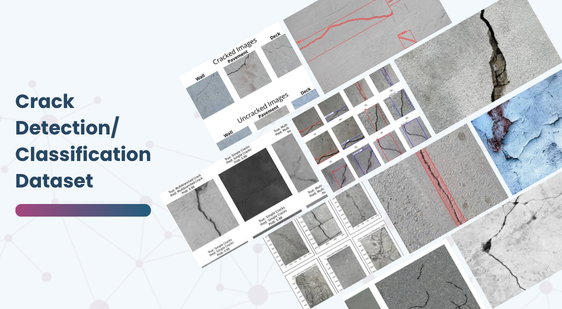
The Crack Detection/Classification Dataset is an image dataset designed for computer vision and machine learning tasks related to crack detection and classification. Researchers and developers can use crack images to train and evaluate models that identify visible cracks in surfaces.
Such datasets can support automated inspection, structural monitoring, computer vision research, and infrastructure maintenance applications.
Dataset Description
Cracks can appear on concrete, roads, bridges, buildings, and other structures. Finding these defects early can help teams monitor structural conditions and plan further inspections.
The Crack Detection/Classification Dataset provides image data for developing computer vision models that can recognize crack-related patterns. Therefore, it can serve as a practical resource for researchers working on image classification and automated visual inspection.
Crack detection is also an important computer vision problem. A model can learn visual differences between cracked and non-cracked surfaces and then use those patterns when analyzing new images.
What Is Crack Detection?
Crack detection uses image processing or machine learning techniques to identify visible cracks in an image. Depending on the task, a model may classify an image as cracked or non-cracked. More advanced systems can also locate the crack or segment its exact region.
For example, binary image classification can determine whether a surface contains a crack. Other computer vision approaches can identify the location, shape, or extent of the damage.
As a result, crack detection datasets can help researchers develop automated inspection systems for different infrastructure applications.
What Can This Dataset Be Used For?
Image Classification
Researchers can use the images to develop classification models that distinguish between crack and non-crack samples.
Computer Vision Research
The dataset can support experiments with convolutional neural networks and other image-based machine learning techniques.
Structural Inspection
Developers can explore automated visual inspection methods that help identify possible surface defects.
Infrastructure Monitoring
Crack detection models can support research into monitoring roads, concrete structures, buildings, bridges, and other infrastructure.
Machine Learning Training
The dataset can provide image examples for training, testing, and evaluating computer vision models.
Machine Learning Use Cases
Crack Classification
A common approach involves training a model to classify images based on whether they show visible cracks. Researchers can compare different algorithms and evaluate their performance.
Deep Learning
Deep learning models can learn visual features from training images. For instance, CNN-based architectures can identify patterns associated with surface cracks.
Image Preprocessing
Researchers can apply resizing, normalization, augmentation, or other preprocessing techniques before training a model. These steps can help prepare images for a specific computer vision workflow.
Model Evaluation
After training, researchers can evaluate models using suitable metrics such as accuracy, precision, recall, and F1-score. The right metric depends on the research objective.
How to Work With the Dataset
Start by reviewing the image folders and understanding the available classes. Next, check image quality and identify any duplicate, damaged, or unsuitable files.
After that, prepare the images for model training. You may resize the images and apply normalization or other preprocessing techniques.
For a classification project, divide the data into suitable training, validation, and testing sets. Then, train a computer vision model and evaluate its results on unseen images.
Finally, compare different approaches and document the model’s strengths and limitations.
Why Is Crack Detection Important?
Manual inspection can require significant time and specialist effort, especially when teams need to examine large structures. Therefore, computer vision can offer useful support for inspection workflows.
Automated systems can help researchers explore faster ways to identify visible defects. However, AI-based crack detection should complement appropriate engineering inspection rather than replace professional assessment.
Furthermore, image-based models may perform differently when they encounter surfaces, lighting conditions, camera angles, or crack patterns that differ from their training data.
Who Can Use This Dataset?
The dataset can support a variety of users:
- Computer vision researchers can test image classification methods.
- Machine learning developers can train and evaluate crack detection models.
- Civil engineering researchers can explore automated inspection techniques.
- Students can use the images for computer vision projects.
- Data scientists can experiment with image preprocessing and classification.
- AI researchers can study automated visual defect detection.
Important Considerations
Image quality can affect crack detection performance. Lighting, surface texture, camera position, image resolution, and background conditions can all influence model predictions.
Therefore, researchers should inspect the dataset carefully before training a model. Data augmentation can also help create more varied training examples when appropriate.
In addition, model performance on a dataset does not guarantee the same performance in real-world inspections. Researchers should test models on suitable unseen data before drawing conclusions about practical performance.
Conclusion
The Crack Detection/Classification Dataset provides a useful resource for computer vision and machine learning research focused on crack identification.
Researchers can use the images for classification, deep learning, image processing, automated inspection, and infrastructure monitoring experiments. Moreover, the dataset can help students and developers learn how computer vision models identify visual defects.
With suitable preprocessing, model evaluation, and real-world validation, crack image datasets can support research into AI-assisted infrastructure inspection and structural condition monitoring.
Contact Us
FAQ
Question 1. What is the Crack Detection/Classification Dataset?
The Crack Detection/Classification Dataset is an image dataset designed for computer vision tasks related to identifying and classifying cracks. It can support machine learning and automated visual inspection projects.
Question 2. What can the Crack Detection/Classification Dataset be used for?
It can be used for crack detection, image classification, computer vision research, infrastructure inspection, surface defect analysis, and machine learning model development.
Question 3. Can this dataset be used for machine learning?
Yes. The dataset can support supervised machine learning and deep learning projects that focus on image-based crack detection and classification.
Question 4. What is crack detection in computer vision?
Crack detection in computer vision uses image analysis and machine learning techniques to identify visible cracks or surface defects in images. This can help automate parts of inspection workflows.
Question 5. Who can use the Crack Detection/Classification Dataset?
Researchers, data scientists, machine learning developers, computer vision engineers, students, and organizations working on automated inspection can use the dataset for research and model development.

Quality Data Creation

Guaranteed TAT

ISO 9001:2015, ISO/IEC 27001:2013 Certified

HIPAA Compliance

GDPR Compliance

Compliance and Security
Let's Discuss your Data collection Requirement With Us
To get a detailed estimation of requirements please reach us.