
TensorFlow Flowers Dataset
TensorFlow Flowers Dataset
Datasets
TensorFlow Flowers
File
Flower Images with Class Labels
Use Case
Image classification, computer vision, deep learning, transfer learning, image recognition, and model training
Description
A labeled flower image dataset containing 3,670 images across five classes: daisy, dandelion, roses, sunflowers, and tulips. It can be used to train and evaluate image classification and computer vision models.

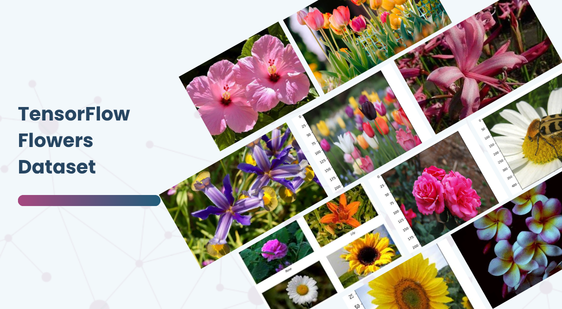
The TensorFlow Flowers Dataset is an image dataset designed for flower classification and computer vision projects. It contains 3,670 images with five flower classes. As a result, it is useful for training and testing machine learning models that can recognize different types of flowers.
Dataset Description
Image classification is a common task in computer vision. A model receives an image and learns to identify the category it belongs to. The TensorFlow Flowers Dataset provides a simple and practical way to work with this type of problem.
The dataset contains 3,670 training examples. Each example includes an image and a class label. The image is stored as a three-channel image, while the label identifies one of five flower categories.
Because the dataset has a focused classification task, it can be useful for students, developers, and researchers who want to practice image-based machine learning.
What Is the TensorFlow Flowers Dataset Used For?
The main purpose of the dataset is image classification. A machine learning model can learn visual patterns from the labeled images and then predict the flower class of new images.
For example, a model may learn differences in color, shape, petals, and overall flower structure. During training, it uses the image-label pairs to improve its predictions.
In addition, the dataset can support several computer vision experiments, including:
- Image classification
- Flower recognition
- Deep learning
- Transfer learning
- Image preprocessing
- Data augmentation
- Model evaluation
- Computer vision research
- Neural network training
Flower Classes
The dataset contains five flower classes. These categories are:
- Daisy
- Dandelion
- Roses
- Sunflowers
- Tulips
Having multiple classes makes the dataset useful for multi-class image classification. Therefore, a model must learn to distinguish between several types of flowers instead of making only a yes-or-no prediction.
Dataset Structure
The TensorFlow dataset provides two main features: image and label. The image feature contains the flower picture, while the label represents its class. The official TensorFlow documentation lists the image data as RGB images and the label as a five-class classification field.
The dataset uses a single train split containing 3,670 examples. Its documented dataset size is about 221.83 MiB, while the download size is about 218.21 MiB.
This structure makes it straightforward to load the data into a computer vision workflow.
How to Use the Dataset
Start by loading the images and their corresponding labels. Next, inspect the images to understand their quality, dimensions, and class distribution.
Image preprocessing is another important step. Depending on the model, images may need to be resized or normalized before training. Data augmentation can also be applied to create variations of training images and improve model robustness.
After preprocessing, split the available data into suitable training and validation sets if your project requires independent evaluation. Then, train a classification model and measure its performance using appropriate metrics.
Machine Learning Use Cases
The TensorFlow Flowers Dataset can support a variety of practical machine learning projects.
Image Classification
A classification model can learn to identify whether an image contains a daisy, dandelion, rose, sunflower, or tulip.
Transfer Learning
Pre-trained computer vision models can be adapted to the flower classification task. This approach can help developers experiment with modern image recognition techniques without training a large model from scratch.
Data Augmentation
Researchers can apply transformations such as rotation, cropping, flipping, or other suitable changes to create more varied training examples.
Model Evaluation
The dataset can also be used to compare different classification approaches. For instance, users can evaluate how different architectures, preprocessing methods, or training settings affect model performance.
Who Can Use the TensorFlow Flowers Dataset?
The dataset is suitable for students, machine learning developers, data scientists, educators, and computer vision researchers.
Beginners can use it to understand the basic stages of an image classification project. Meanwhile, experienced developers can use it to test preprocessing methods, transfer learning approaches, or model architectures.
It can also work well for educational demonstrations because the classification task is easy to understand and the dataset has clearly defined categories.
Benefits of the Dataset
One major advantage is its simple structure. Each example contains an image and a corresponding class label, making the dataset easy to understand and integrate into a computer vision workflow.
Furthermore, the five-class setup provides enough variety for meaningful classification experiments. Users can practice the complete machine learning process, from data loading and preprocessing to model training and evaluation.
The dataset is also documented by TensorFlow, which makes it easier for developers to understand its structure and use it in TensorFlow-based projects.
Things to Consider
Image classification performance can depend on several factors. Image quality, lighting, backgrounds, class differences, preprocessing, and model architecture may all affect results.
Therefore, users should evaluate their models carefully rather than relying only on training accuracy. Validation performance and other suitable evaluation metrics can provide a better understanding of how well a model generalizes.
It is also important to remember that a model trained on this dataset may not perform equally well on flower images captured in completely different environments.
Conclusion
The TensorFlow Flowers Dataset is a practical resource for learning and developing image classification models. With 3,670 labeled images across five flower classes, it provides a focused dataset for computer vision and deep learning experiments.
Whether you are learning image classification, testing transfer learning, or exploring computer vision techniques, this dataset provides a useful starting point. Its simple image-and-label structure also makes it suitable for educational projects and machine learning experiments.
Source: Kaggle – TensorFlow Flowers
Contact Us
FAQ
Question 1. What is the TensorFlow Flowers Dataset?
The TensorFlow Flowers Dataset is a labeled image dataset designed for flower classification and computer vision projects.
Question 2. How many images are in the TensorFlow Flowers Dataset?
The dataset contains 3,670 images in its training split.
Question 3. Which flower classes are included?
The dataset contains five flower categories: daisy, dandelion, roses, sunflowers, and tulips.
Question 4. What can the TensorFlow Flowers Dataset be used for?
It can be used for image classification, computer vision, deep learning, transfer learning, image recognition, data augmentation, and model evaluation.
Question 5. Is the TensorFlow Flowers Dataset suitable for beginners?
Yes. Its straightforward image-and-label structure makes it a useful dataset for learning image preprocessing, classification, neural network training, and model evaluation.

Quality Data Creation

Guaranteed TAT

ISO 9001:2015, ISO/IEC 27001:2013 Certified

HIPAA Compliance

GDPR Compliance

Compliance and Security
Let's Discuss your Data collection Requirement With Us
To get a detailed estimation of requirements please reach us.