
Dog Emotion Dataset
Dog Emotion Dataset
Datasets
Dog Emotion Dataset
File
Dog Emotion Dataset
Use Case
Dog Emotion Classification, Computer Vision, Image Classification, Deep Learning, Animal Emotion Recognition, Machine Learning
Description
An image-based dataset containing dog images for studying and classifying represented emotional expressions. It can be used for computer vision, image classification, deep learning, image preprocessing, data augmentation, and animal emotion recognition projects.
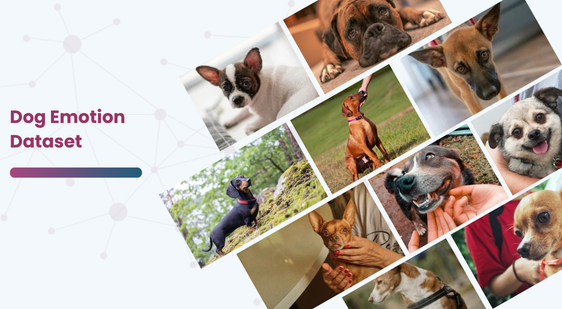
Dataset Overview
The Dog Emotion Dataset provides images that researchers and machine learning practitioners can use to study and classify different emotional expressions in dogs. The dataset offers a practical resource for computer vision, image classification, deep learning, and animal emotion recognition projects.
Students, researchers, and AI developers can use these images to practice image preprocessing, data augmentation, model training, and performance evaluation. The dataset also provides an opportunity to explore how AI models recognize visual patterns in animal images.
What Is the Dog Emotion Dataset?
The Dog Emotion Dataset contains dog images that users can analyze to identify visual patterns associated with different emotion categories. Researchers can examine features such as facial appearance, posture, and other visible characteristics when developing image classification models.
The dataset provides a useful starting point for computer vision experiments. Users can train models to recognize the emotion categories represented in the dataset and evaluate how accurately those models classify new images.
Key Features
Dog Emotion Images
The dataset provides dog images that researchers can analyze to explore differences between represented emotional categories.
Image Classification
Users can train image classification models to recognize emotion labels associated with dog images.
Computer Vision Research
The dataset supports computer vision experiments involving animal images, visual features, and image classification.
Deep Learning Applications
Users can experiment with convolutional neural networks (CNNs), transfer learning, and other deep learning approaches for image classification.
What Can This Dataset Be Used For?
The Dog Emotion Dataset supports several applications:
Dog Emotion Classification: Train models to classify the emotion categories represented in the images.
Computer Vision: Develop and test image classification workflows.
Deep Learning: Experiment with CNNs and transfer-learning models.
Image Processing: Practice resizing, normalization, image augmentation, and other preprocessing techniques.
Model Evaluation: Measure classification performance using accuracy, precision, recall, and F1-score.
Academic Projects: Use the dataset for student projects and research involving computer vision and animal-related AI.
Potential Applications
Animal Emotion Recognition
Researchers can explore how visual characteristics in dog images relate to different emotion categories. This can help users understand the challenges involved in recognizing animal expressions through computer vision.
Computer Vision Models
Machine learning practitioners can use the images to develop and evaluate image classification models. They can compare different algorithms and analyze model performance.
Deep Learning Projects
The dataset provides a practical resource for experimenting with CNN architectures, transfer learning, and other deep learning methods.
Educational Projects
Students can use the dataset to learn image preprocessing, dataset splitting, model training, validation, and classification evaluation.
Why Is This Dataset Useful?
Emotion recognition presents an interesting computer vision challenge because dogs can display different visual characteristics depending on breed, pose, lighting, image quality, and individual behavior.
The Dog Emotion Dataset allows users to explore these challenges while developing practical machine learning and computer vision skills. It also demonstrates how image datasets can support AI applications beyond traditional object detection and classification.
Users should not treat model predictions as definitive assessments of a dog’s emotional or behavioral state. AI models can make classification errors, and visual labels may not represent the full complexity of animal behavior.
Who Can Use This Dataset?
The dataset can benefit:
Machine learning students
Data science students
Computer vision researchers
AI developers
Deep learning practitioners
Academic researchers
Educators and instructors
Conclusion
The Dog Emotion Dataset provides a practical resource for exploring dog emotion classification through computer vision and machine learning. Users can apply it to image classification, deep learning, image preprocessing, and academic research projects.
Researchers and students can use the dataset to develop practical AI skills, investigate visual patterns, and experiment with models that analyze animal images.
Dataset Source: This dataset is sourced from Kaggle.
Contact Us
FAQ
Question 1. What is the Dog Emotion Dataset?
The Dog Emotion Dataset is an image dataset designed for studying and classifying different emotional expressions in dogs using computer vision and machine learning techniques.
Question 2. What can the Dog Emotion Dataset be used for?
It can be used for dog emotion classification, image classification, computer vision, deep learning, image processing, and academic research projects.
Question 3. Can this dataset be used for machine learning?
Yes. Users can use the dataset to train and evaluate machine learning and deep learning models for image-based emotion classification.
Question 4. Who can use the Dog Emotion Dataset?
The dataset can be useful for students, researchers, data scientists, AI developers, and machine learning practitioners working on computer vision and animal-related AI projects.
Question 5. How can I analyze the Dog Emotion Dataset?
You can analyze the images using Python and computer vision or deep learning frameworks. Common steps include image preprocessing, data augmentation, model training, validation, and performance evaluation.

Quality Data Creation

Guaranteed TAT

ISO 9001:2015, ISO/IEC 27001:2013 Certified

HIPAA Compliance

GDPR Compliance

Compliance and Security
Let's Discuss your Data collection Requirement With Us
To get a detailed estimation of requirements please reach us.