
Forward Looking Sonar Object Detection Dataset
Forward Looking Sonar Object Detection Dataset
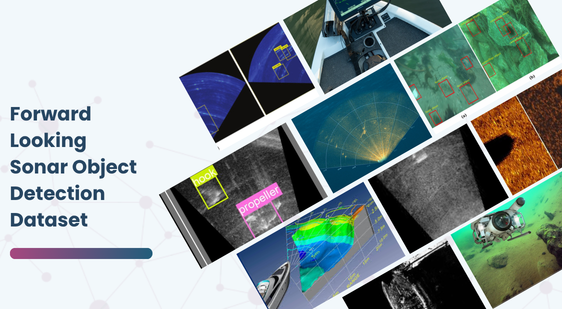
The Forward Looking Sonar Object Detection Dataset provides sonar images that researchers can use to explore object detection and recognition in underwater environments.
Forward-looking sonar plays an important role in underwater robotics because it allows vehicles to observe objects ahead of them. For example, researchers can use sonar data to develop systems that identify potential obstacles, underwater objects, or targets during navigation and inspection tasks.
Moreover, sonar imagery differs significantly from conventional RGB images. Objects often appear through acoustic reflections and shadows rather than familiar photographic details. Consequently, AI models need to learn different visual patterns when working with sonar data.
What Is Forward-Looking Sonar?
Forward-looking sonar (FLS) is an acoustic sensing technology that helps underwater systems observe the area in front of them. The sonar sends sound waves through the water and analyzes the returning echoes to create an image of the surrounding environment.
As a result, underwater vehicles can use forward-looking sonar to detect objects without depending entirely on optical cameras. This capability becomes particularly useful when water conditions reduce visibility.
Furthermore, sonar imagery gives computer vision researchers an opportunity to develop models specifically for acoustic image interpretation and underwater object detection.
Key Applications of the Dataset
Researchers and developers can use this dataset for several AI and underwater technology applications.
Underwater Object Detection
The dataset can help researchers train object detection models to locate objects within sonar images. In addition, researchers can compare different deep learning architectures and evaluate their detection performance.
Sonar Image Analysis
Researchers can also use the images to study sonar-specific image patterns. For instance, they can investigate preprocessing, feature extraction, image enhancement, and classification techniques.
Autonomous Underwater Vehicles
AUVs need reliable perception systems to navigate underwater environments. Therefore, sonar object detection models can contribute to systems that help autonomous vehicles identify objects and potential obstacles.
Remotely Operated Vehicles
ROVs often operate in environments where visibility can change quickly. Consequently, sonar-based perception can support underwater inspection, exploration, and monitoring tasks.
Marine Robotics Research
The dataset can also support academic and industrial research involving marine robotics, underwater AI, deep learning, and autonomous systems.
Why Is Sonar Data Important for AI?
Conventional camera images do not always provide reliable information underwater. Water can become dark, cloudy, or filled with particles, which makes visual object recognition difficult.
However, sonar provides another way to perceive the underwater environment. Therefore, researchers can combine sonar data with AI techniques to develop more robust underwater perception systems.
At the same time, sonar data introduces its own challenges. Models must learn to handle acoustic noise, reverberation, shadows, clutter, and variations in object appearance.
Because of these challenges, sonar datasets provide a valuable environment for testing the robustness and generalization of computer vision models.
Machine Learning Use Cases
The dataset supports several machine learning and deep learning experiments.
Object Detection Models
Researchers can train object detection models to identify and localize objects in sonar imagery. They can then compare different architectures based on metrics such as precision, recall, IoU, and mean Average Precision (mAP).
Transfer Learning
Researchers can also investigate transfer learning approaches. For example, a model trained on a related computer vision task can provide a starting point for training on sonar imagery.
Data Augmentation
Sonar images can contain variations caused by distance, object orientation, noise, and underwater conditions. Therefore, researchers can experiment with augmentation techniques to improve model robustness.
Feature Extraction
The dataset can help researchers investigate which visual and acoustic patterns allow AI models to distinguish objects from the surrounding underwater environment.
Challenges in Sonar Object Detection
Sonar-based object detection presents several challenges. Understanding these challenges can help researchers design more reliable models.
Acoustic Noise
Sonar images may contain unwanted acoustic signals and reflections. Consequently, models may find it difficult to distinguish important object features from background noise.
Complex Backgrounds
The seabed and surrounding underwater structures can create visual clutter. Therefore, an object may blend into its surroundings in a sonar image.
Small Objects
Objects located far from the sonar sensor can appear relatively small. As a result, detecting these targets can require models that handle small objects effectively.
Object Appearance
An object’s sonar representation can change depending on its distance, orientation, position, and relationship to the sonar sensor. Thus, models need to learn patterns across different conditions.
Who Can Use This Dataset?
The Forward Looking Sonar Object Detection Dataset can benefit a wide range of users, including:
- AI and machine learning researchers
- Computer vision engineers
- Robotics researchers
- Marine technology developers
- AUV developers
- ROV developers
- Sonar technology researchers
- Students working on deep learning projects
- Researchers studying underwater perception
In addition, students can use the dataset for academic projects involving object detection, image classification, deep learning, and underwater computer vision.
Potential AI Model Development
Researchers can experiment with various deep learning approaches using this dataset. For example, they can evaluate YOLO-based object detectors, CNN-based architectures, transformer-based models, and transfer learning techniques.
Furthermore, researchers can compare model performance using standard object detection metrics. This approach can help identify models that provide better accuracy and reliability for sonar imagery.
Researchers can also combine preprocessing and augmentation techniques with different detection architectures. As a result, they can study how each approach affects model performance.
Benefits for Underwater Computer Vision
The dataset provides an opportunity to study computer vision outside conventional photographic environments. Instead of relying on RGB images, researchers can explore how AI systems interpret acoustic representations of underwater objects.
Moreover, this type of research can contribute to the development of more capable underwater perception systems. These systems may eventually support autonomous navigation, marine inspection, underwater exploration, search operations, and robotic applications.
Conclusion
The Forward Looking Sonar Object Detection Dataset is a useful resource for underwater object detection, computer vision, deep learning, and marine robotics. It helps researchers develop AI models that can identify objects in challenging underwater environments.
Explore more AI training datasets and computer vision datasets on GTS.ai for machine learning and deep learning projects.
Contact Us
FAQ
Question 1. What is the Forward Looking Sonar Object Detection Dataset?
The Forward Looking Sonar Object Detection Dataset is a collection of sonar images designed for underwater object detection, computer vision, and machine learning. Researchers can use it to train and evaluate AI models that identify objects in underwater environments.
Question 2. What is forward-looking sonar used for?
Forward-looking sonar helps underwater systems detect and observe objects ahead of them. It is useful for underwater navigation, marine exploration, AUVs, ROVs, inspection, and robotics, especially when water conditions limit camera visibility.
Question 3. What can I use this sonar dataset for?
You can use the dataset for sonar image analysis, object detection, deep learning, computer vision research, and underwater robotics projects. It can also help researchers test different object detection and image-processing techniques.
Question 4. Why is underwater sonar object detection challenging?
Sonar images can contain acoustic noise, background clutter, shadows, and small or unclear objects. In addition, an object’s appearance can change based on its distance, position, and orientation. Therefore, AI models need to handle several challenging underwater conditions.
Question 5. Which AI models can be used with this dataset?
Researchers can experiment with YOLO-based models, CNN-based object detectors, transformer-based architectures, and transfer learning approaches. They can evaluate model performance using metrics such as precision, recall, IoU, and mAP.


Quality Data Creation

Guaranteed TAT

ISO 9001:2015, ISO/IEC 27001:2013 Certified

HIPAA Compliance

GDPR Compliance

Compliance and Security
Let's Discuss your Data collection Requirement With Us
To get a detailed estimation of requirements please reach us.